Exploring anatomy through hands-on toys helps young learners connect concepts like bones, organs, and systems with real-world understanding. The following selections are designed for roughly five-year-olds, offering safe, engaging ways to learn about the human body. Each option combines tactile learning with clear visuals, making it easier for kids to grasp basic physiology while staying curious and motivated to explore more.
Summary Of Selected Products
| Product | Brand | Key Feature | Amazon Link |
|---|---|---|---|
| Be Amazing! Interactive Human Body | Be Amazing! Toys | Fully poseable 14″ model with bones, muscles, organs | View |
| Melissa & Doug Magnetic Human Body | Melissa & Doug | 24 magnets with a wooden stand for visualization | View |
| Kidzlane My Body Puzzle | Kidzlane | Five-layer wooden puzzle showing skeletal to digestive systems | View |
| QUOKKA Fully Assembled Busy Book | QUOKKA | Nearly 200 elements pre-attached, 15 themes | View |
| NUHICO This Is Me! Felt Anatomy Set | NUHICO | 30 detachable organs and bones, large 35.4-inch size | View |
Be Amazing! Interactive Human Body
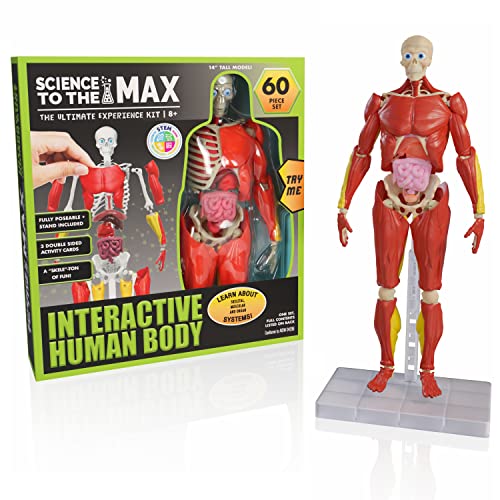
The Be Amazing! Interactive Human Body offers a 14-inch fully articulated model designed for hands-on anatomy exploration. With removable muscles, organs, and bones, kids can observe how parts fit together and move. The model’s adjustable stand supports various poses, enabling demonstrations of body mechanics and spatial relationships between structures. Its realistic proportions and comprehensive components make it a strong choice for curious 5-year-olds beginning to learn anatomy through play.
Melissa & Doug Magnetic Human Body

This magnetic play set provides a wooden figure with a collection of 24 magnets representing organs and body parts. Children can arrange magnets on the figure to visualize systems like the circulatory and digestive systems while guided by the included package guide. The magnetic pieces offer a tactile way to reinforce memory and recognition of where organs sit within the torso, supporting early scientific reasoning in a classic pretend-play format.
Kidzlane My Body Puzzle

The Kidzlane five-layer wooden puzzle teaches skeletal, muscular, respiratory, and digestive systems with sturdy 29-piece construction. Each layer reveals a different aspect of anatomy, encouraging problem-solving, fine motor skills, and spatial thinking as kids fit pieces into place. The puzzle is durable and designed for repeated play, making it suitable for classroom or home use by young learners exploring human biology.
QUOKKA Fully Assembled Busy Book

QUOKKA’s busy book comes fully assembled with nearly 200 pre-attached elements and 15 themes, making it a robust option for independent exploration. The pages cover human anatomy, brain function, senses, skin, bones, and more, fostering curiosity and long-term engagement. The readiness-to-play aspect is ideal for travel and classroom settings, where teachers or parents want a comprehensive resource without setup time.
NUHICO This Is Me! Felt Anatomy Set

The NUHICO felt anatomy set scales up to 35.4 inches tall and includes 30 detachable organs and bones. Felt pieces attach with Velcro for easy manipulation, providing a tactile approach to learning key anatomical concepts. Its larger size helps children visualize proportions and relationships between organs, promoting sustained engagement and classroom-ready demonstrations.
Buying Guide: Key Purchase Considerations
- Age-appropriateness: Choose toys labeled for preschool to early elementary ages, focusing on safety and manageable complexity for five-year-olds.
- Hands-on appeal: Look for reconfigurable models, magnets, or Velcro attachments to encourage motor skill development and tactile learning.
- Progression and depth: Consider whether the toy covers multiple body systems (skeletal, muscular, circulatory, digestive) to build a coherent mental model over time.
- Durability and materials: Wooden pieces and fabric/felt components generally withstand frequent use and travel better than small plastic parts.
- Safety and standards: Check for child-safe materials, smooth edges, and compliance with safety regulations for toys aimed at young children.
- Storage and portability: Sturdy cases or compact layouts help maintain order and support learning on the go.
- Learning format: Some children benefit from guided activities, while others prefer free play. A mix of open-ended and structured tasks can be ideal.
- Teacher and caregiver support: Visual guides or included activity ideas help adults facilitate learning without additional prep.
In selecting anatomy toys for five-year-olds, it is useful to balance realism with age-appropriate interaction. The items above provide structured visuals (magnetic sets and structured puzzles) and imaginative play (plush or felt models) to support early biology literacy. Parents and educators can combine options to cover anatomy from multiple angles—hands-on manipulation, storytelling, and guided demonstrations—to reinforce concepts while keeping children engaged.