Bridge building kits provide tangible, inquiry-driven learning for students exploring force, load, and structural design. This guide highlights five top kits that align with classroom needs, from elementary to middle school. Each selection emphasizes hands-on construction, real-world engineering concepts, and scalable activities suitable for group work or individual projects.
| Product | Brand | Key Focus |
|---|---|---|
| Thames & Kosmos Structural Engineering: Bridges & Skyscrapers | Thames & Kosmos | Force, load, compression, tension |
| Learning Resources STEM Explorers Bridge Builders | Learning Resources | Real-world engineering challenges |
| Pathfinders STEM Kit – Bridge Building | Pathfinders | Gears, pulleys, counterweights |
| V Generations Bridges & Buildings STEM Kit | V Generations | 15+ models, 250 pieces |
| K’NEX Architecture: Golden Gate Bridge | K’NEX | Large-scale, authentic replica |
Thames & Kosmos Structural Engineering: Bridges & Skyscrapers

This comprehensive kit introduces students to core concepts of structural engineering through 20 distinct models. Learners explore force transmission, load distribution, compression, and tension as they build. The system includes over 285 interchangeable pieces and a 36-page illustrated manual guiding experiments and assembly. The open-ended model set supports collaborative projects and differentiation for varied skill levels.
Learning Resources STEM Explorers Bridge Builders

This kit invites students to solve nine STEM challenges by designing and testing bridges and towers. It covers suspension and beam concepts and introduces real-world engineering principles. As students test designs and iterate, they practice critical thinking and problem-solving—key outcomes for science and math curricula. The kit is suitable for classroom use and small groups, with guidance to scaffold for younger learners.
ROBOTIME 3D Puzzle London Tower Bridge

This 3D wooden puzzle introduces structural elements through a London Tower Bridge model with LED lighting. The kit emphasizes spatial reasoning, assembly sequencing, and tactile learning. With 113 pieces and a 14.1 x 2.9 x 4.6 inch footprint, it makes a visually compelling classroom display and a hands-on activity that can be completed with adult guidance. It is well-suited for teens and curious younger students exploring architecture.
Pathfinders STEM Kit – Bridge Building
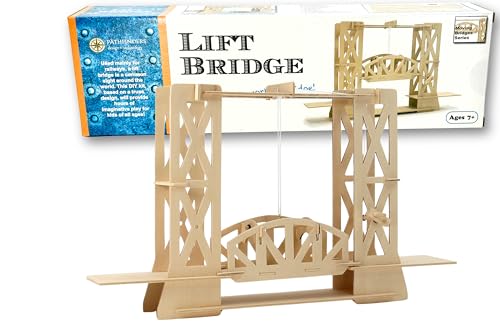
Designed for a focused, practical build, this kit centers on a functioning lift bridge. Students work with gears, pulleys, and counterweights to understand motion and force transfer. A roughly 60-minute build helps maintain student engagement while delivering meaningful outcomes in mechanical engineering concepts. The straightforward instructions support classroom use and independent student exploration.
V Generations Bridges & Buildings STEM Kit

With more than 250 pieces, this kit enables students to build over 15 models of bridges and buildings. It emphasizes practical science and engineering concepts such as force, load, compression, and tension. The variety supports differentiated instruction and larger group projects, making it useful for classrooms that require scalable challenges and multiple outcomes across grades 3–8.
K’NEX Architecture: Golden Gate Bridge

This expansive set offers a substantial construction experience with 1,536 pieces and a build that stretches over 40 inches long. It encourages long-term project work and can be scaled for advanced learners who want to explore structural integrity, load paths, and architectural design. Clear, step-by-step instructions help students become proficient builders while engaging in collaborative engineering challenges.
Buying Guide
- Curriculum alignment: Choose kits that map to standards for engineering, technology, and science, with explicit learning outcomes.
- Age and skill fit: Consider the age range, complexity, and needed adult support to ensure classroom suitability.
- Scalability: Look for sets that support both small-group work and larger-group demonstrations, with modular experiments to suit different classes.
- Materials and durability: Prefer kits with sturdy pieces and safe, non-toxic materials that withstand repeated use in a school setting.
- Assessment opportunities: Favor kits that include observation prompts, built-in challenges, or activity sheets to measure student progress.
- Storage and organization: Check whether the kit provides organizers or trays to maintain order in a busy classroom.
- Interdisciplinary potential: Select kits that tie into math, science, art, and design to maximize cross-curricular learning.
- Teacher support: Prioritize kits offering clear manuals, lesson ideas, and troubleshooting tips to minimize planning time.
For classrooms, combining a core set like a structural engineering kit with supplementary building kits can accommodate varied learning pace and diverse learners. Consider pairing hands-on construction with short reflective tasks, such as sketching load paths, calculating approximate ratios of forces, or presenting findings to peers. This approach builds both practical skills and critical thinking, essential for foundational engineering literacy in school settings.