Finding engaging, educational rocket kits for kids helps blend building projects with science and exploration. The following five products represent beginner to intermediate options that emphasize hands-on learning, problem solving, and safe outdoor play. Each selection includes clear assembly steps, age ranges, and compatible accessories to expand play and learning over time.
Overview of selected products
| Product | Brand | Recommended Age | Approx. Type | Key Benefit |
|---|---|---|---|---|
| Estes 1469 Tandem X Rocket Launch Set | Estes | 10+ | Two beginner rockets | High altitude duo for varied flight experiences |
| Smartivity DIY Rocket Launcher STEM Kit | Smartivity | 6-14 | DIY rocket launcher | Screen-free, hands-on STEM project |
| Estes 1441 Journey Launch Set | Estes | 10+ | Launch pad + controller | Simplified, consistent launches for beginners |
| Estes 1225 Alpha Rocket-Building Kit | Estes | 10+ | Intermediate model rocket | Structured build with teachable design |
| PLAYSTEM Outdoor Water Powered Rocket Set | PLAYSTEAM | 6-12 | Water-powered rocket kit | Outdoor STEM with water propulsion |
Estes Tandem X Rocket Launch Set

The Estes 1469 Tandem X kit is designed for beginners and provides two rockets with differing flight profiles. The set includes the easy-to-assemble Amazon model with plastic fins and decals, plus the Crossfire ISX model featuring laser-cut wood fins and decals. It requires additional components such as rocket engines, starters, recovery wadding, and AA batteries for launch control, all sold separately. This duo supports longer, varied play sessions and a broader introduction to model rocketry.
Flight capabilities include a 30-inch Amazon rocket projected to 600 feet with a C6-5 engine and a 15.6-inch Crossfire ISX reaching about 1,150 feet with a C6-7 engine. The kit is compatible with several Estes engines, enabling experimentation with different thrust profiles. Assembly options cater to different skill levels, making it a versatile beginner-to-intermediate experience.
Smartivity DIY Rocket Launcher Kit

The Smartivity Rocket Launcher is a hands-on STEM project that guides kids through building a functional launcher and rocket. The kit emphasizes 100% screen-free play, with an instructional manual designed to engage children aged around 6 to 14. Assembling the rocket and launcher boosts critical thinking, planning, and problem-solving skills, while launching reinforces basic physics concepts in a safe outdoor setting. A replacement-parts policy adds long-term value for repeated builds.
Key strengths include clear, step-by-step directions, durable parts, and a strong focus on developing confidence in STEM tasks. The activity supports independent and guided play, making it suitable for home tinkering or classroom-style STEM sessions. The included lifetime replacement parts ensure continued use beyond initial sessions.
Estes Journey Launch Set

The Estes 1441 Journey Launch Set is a beginner-friendly option that comes with a launch pad, a launch controller, decals, and a parachute. Builders will use engines, starters, recovery wadding, and AA batteries for operation (sold separately). Its design supports straightforward assembly in about an hour, making it an ideal first project for young enthusiasts who want a tangible sense of progress from start to flight.
With a projected altitude around 1,100 feet using a C6-7 engine, this kit offers a satisfying flight experience while remaining approachable for newcomers. It is compatible with other common Estes engines, giving kids room to experiment with different power levels and flight characteristics as they grow more confident in their building and piloting abilities.
Estes 1225 Alpha Rocket-Building Kit

The 1225 Alpha kit is categorized as intermediate, offering a more involved build than entry-level sets. It includes rocket parts, decals, recovery parachutes, and instructions, with launch requirements such as engines, starters, recovery wadding, a Porta Pad II Launch Pad, and an Electron Beam Launch Controller. Assembly takes about an hour, and the design supports STEM exploration through aerodynamics and propulsion concepts while maintaining approachable complexity for motivated kids aged 10 and up.
Compatibility with a range of Estes engines allows families to tailor flights. The kit’s balanced design helps teach sequencing, design, and iterative testing, which are fundamental to successful model rocketry and related STEM pursuits.
PLAYSTEM Outdoor Water Powered Rocket Kit
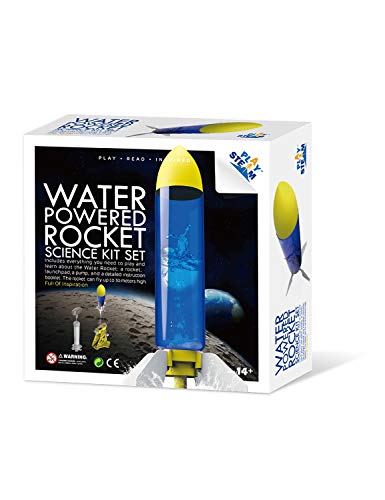
This water-powered rocket set introduces a refreshing approach to rocket science. The kit includes a rocket body, tail, launcher, and a pump, with the option to reuse a plastic bottle for the body. Step-by-step assembly instructions guide kids through safe, hands-on construction, and the water pressure mechanism can launch rockets up to around 100 feet. Safety features include a valve that regulates excess pressure, making it suitable for supervised outdoor play.
The PLAYSTEM set emphasizes environmental-friendly materials and repeatable experimentation, enabling kids to explore physics concepts like thrust, pressure, and aerodynamics without combustion-based engines. It’s a practical entry point for younger children to experience the thrill of lift-off and space-themed pretend play.
Buying Guide: Key Purchase Considerations
- Age and skill level: Start with beginner sets if the child is new to building and flight. Move up to intermediate kits as confidence and interest grow.
- Safety and supervision: Ensure outdoor use, follow launcher instructions, and supervise launches, especially with younger children.
- Flight duration and altitude: Consider how high or how long a flight should be to match the child’s interests and local regulations or open space availability.
- Parts availability and support: Options with replacement parts and straightforward assembly reduce downtime and frustration.
- Expandability: Choose kits that allow engine or accessory upgrades to extend learning and play over time.
- Material and durability: Wooden or composite components may offer longer-lasting builds and a tactile learning experience.
- Maintenance needs: Some kits require batteries, wadding, or specific fuels; others rely on water propulsion or simple mechanical launchers for lower upkeep.
- Educational value: Look for kits that emphasize STEM concepts such as aerodynamics, thrust, stability, and basic wiring or electronics where appropriate.
Across these options, families can tailor experiences by blending building, launching, and observing outcomes. Whether exploring gravity and thrust with water-propelled rockets or learning through laser-cut fins and decals, each kit provides a structured path to hands-on science learning outside the classroom.