Young builders thrive when they can turn ideas into tangible creations. The following hand-picked STEM kits and robotics sets are designed to spark curiosity, nurture problem-solving, and provide screen-free play that still feels like high-tech fun. Each option below targets ages around 12, offering engineering challenges, programmable features, and durable components for long-lasting learning adventures.
| Product | Brand | Primary Focus |
|---|---|---|
| Smartivity DIY Robotic Mechanical Hand | Smartivity | Mechanical robotics and hands-on construction |
| ELEGOO UNO R3 Smart Robot Car Kit V4 | ELEGOO | Arduino-based robotics, programming, sensors |
| 13-in-1 Solar Power Robots | Bottleboom | Solar-powered robotics, multiple builds |
| Henoda APP/Remote Control Robot Toys | Henoda | Programmable robot with multiple control modes |
| NATIONAL GEOGRAPHIC Da Vinci Model Kit | Blue Marble | Engineering models with wooden components |
Smartivity DIY Robotic Mechanical Hand

The Smartivity DIY Robotic Mechanical Hand engages kids in a step-by-step construction process that results in a functional mechanical hand. The kit emphasizes screen-free engagement while teaching core concepts in physics and engineering. Its instructional manual guides builders through each stage, helping develop planning, fine motor skills, and an understanding of leverage and motion. Suitable for ages 8 through 14, it supports independent exploration or guided projects with peers.
Key features include a comprehensive parts set, durable materials, and a design that encourages experimentation. Replacement parts are available, minimizing downtime and extending playtime. Assembling the hand illustrates how simple machines combine to form more complex mechanisms, aligning well with school science standards and long-term curiosity in STEM topics.
ELEGOO UNO R3 Smart Robot Car Kit V4

The ELEGOO UNO R3 Smart Robot Car Kit V4 introduces beginners to programming, electronics assembly, and robotics. It serves as a versatile foundation for exploring autonomous navigation, sensor integration, and remote-controlled features. The kit includes multiple modules such as obstacle avoidance and line tracing, and it can be controlled via Android or iOS devices in addition to traditional microcontroller interfaces. Its modular design reduces assembly errors and supports iterative experimentation.
Educational value centers on practical coding and electronics fundamentals, making it suitable for students who want a tangible project that scales with growing skills. It encourages problem-solving, experimentation, and collaboration as learners test different control strategies and sensor setups.
13-in-1 Solar Power Robots

Bottleboom’s 13-in-1 Solar Power Robots kit lets builders follow a guided manual to assemble a dozen different robots powered by solar energy. The set covers ground and water-capable designs, teaching energy conversion, gear systems, and engineering versatility. Parts are designed for repeated assembly and disassembly, supporting exploration of multiple configurations and rewards curiosity with visible energy flow and motion.
Materials are chosen to be safe for young builders, and the kit emphasizes safe hands-on experimentation. The solar approach reinforces sustainable thinking and demonstrates how renewable energy sources can drive mechanical motion without batteries or motors, aligning with practical science education goals.
Henoda APP/Remote Control Robot Toys
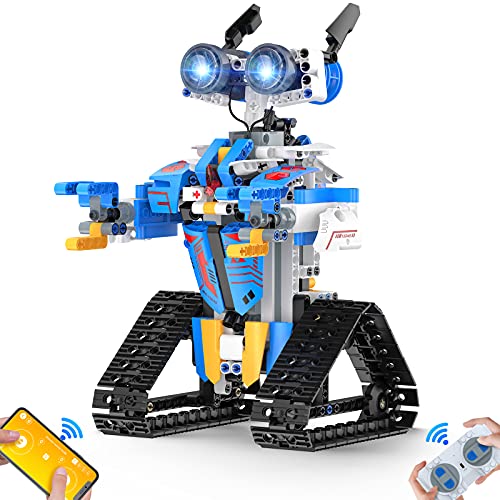
Henoda offers a robust robot building experience with 468+ pieces and multiple control modes, including a smartphone app, Bluetooth, 2.4 GHz remote, and voice or STEM programming modes. The robot’s flexible joints, glowing eyes, and rotating hands provide engaging, interactive play that fosters spatial reasoning, motor skills, and programming mindset. The remote distance exceeds typical wearables, enabling collaborative or competitive play among peers or family members.
In addition to entertainment value, Henoda’s platform supports experimentation with different control schemes, sensors, and motion patterns. This makes it well-suited for students who enjoy hands-on robotics and want to explore how software and hardware work together to produce intelligent behavior.
NATIONAL GEOGRAPHIC Da Vinci Model Kit

The National Geographic Da Vinci Model Kit features a trio of historically inspired machines—the Ballista, Bombard, and Catapult—alongside laser-cut wooden components and clear instructions. Builders create functional models capable of projecting projectiles within a safe play range. The kit emphasizes mechanical design, structural integrity, and iterative testing as part of the building process.
With a focus on constructive engineering, this kit provides a tactile, low-tech yet high-engagement experience that complements digital learning. It’s suitable for classroom demonstrations or family workshops, encouraging planning, measurement, and hands-on assembly as core components of STEM education.
Buying Guide: Key Purchase Considerations And Comparisons
- Age-appropriate challenges: Assess the builder’s current skill level and whether the kit scales in complexity. Look for sets that offer multiple configurations or expandable components to grow with the learner.
- Educational focus: Determine whether the emphasis is on mechanical understanding, programming, energy systems (solar or electrical), or a blend of these. Different kits support different learning goals, from physics principles to robotics programming.
- Hardware quality and durability: Durable plastics, laser-cut wood, and modular components reduce wear and tear and encourage longer-term exploration.
- Ease of assembly vs. depth of exploration: Some kits emphasize quick builds, while others prioritize deep, iterative problem solving. A balance helps sustain interest without excessive frustration.
- Instructional support: Clear manuals, step-by-step guides, and replacement parts are valuable for ongoing play. Public reviews or teacher resources can also inform suitability.
- Programming and sensors: If a kit includes coding or sensor modules, consider compatibility with familiar platforms (Arduino, Scratch, mobile apps) and the learning curve involved.
- Safety and materials: Check for non-toxic materials and age-appropriate small parts. Look for evidence of safety certifications or user feedback on safety.
- Project variety and versatility: Kits offering multiple builds or modes encourage creativity and prevent boredom, especially for curious 12-year-olds.
- Upgrade potential: Some systems allow additional modules or future expansions, making the initial purchase more valuable over time.
- Group learning suitability: If the project is used in a classroom or family setting, ensure the kit supports collaborative work and has roles for multiple participants.
In summary, the best building projects for a 12-year-old combine engaging hands-on mechanics with opportunities to learn essential STEM concepts. Consider whether the child prefers robots, solar-powered engineering, or classic model-building, and choose a kit that offers growth, clear instructions, and durable components. The options above cover a range of interests—from programmable robots to solar models and historical engineering models—providing a solid foundation for ongoing curiosity and skill development.