Older kids craving hands-on challenges will find stimulating options in building toys that blend engineering, robotics, and creative design. This guide highlights five top options that foster problem solving, spatial reasoning, and collaboration, without screens. Each pick offers substantial piece counts, durable components, and clear learning outcomes. Explore how these sets support experimenting with mechanics, energy, and construction while keeping play exciting and educational for preteens and teens.
| Product | Target Age | Focus Area |
|---|---|---|
| Sillbird Solar Robot Building Kit | 8–13 | Renewable energy, robotics |
| Bottleboom 13-in-1 Solar Robot Kit | 8+ | Solar-powered robotics, engineering |
| Henoda Remote-Controlled Robot Kit | 8–16 | Remote control, programmable building blocks |
| Tsomtto 10-in-1 STEM Building Set | 4–8 (primary), 8+ for complexity | Multiple models, hands-on engineering |
| BeAndge 5-Set STEM Kits | 8–12+ | Robotics, mechanics, experimentation |
Sillbird 12-in-1 Solar Robot Building Kit
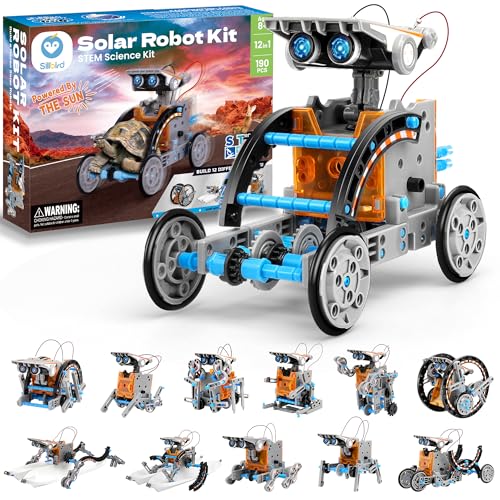
The Sillbird solar robot kit provides 190 pieces designed to build multiple solar-powered automata. Students can assemble, test, and iterate designs outdoors or under strong indoor lighting. With solar energy as the primary power source, this kit encourages experimentation with renewable energy concepts and real-time problem solving. The set aims to develop hands-on engineering skills, spatial reasoning, and basic circuitry comprehension as kids transform solar input into movement and action.
STEM 13-in-1 Solar Power Robots

This 13-in-1 solar robot kit from Bottleboom enables builders to split and reassemble components into diverse vehicles and creatures, all powered by solar energy. The kit includes gears, plates, tires, and connecting parts for landed or water-based robots. It also comes with a concise user manual to guide each build. The fascination lies in testing different configurations to observe how design decisions impact mobility, stability, and efficiency, reinforcing core STEM concepts through iterative play.
BeAndge STEM Kits: 5 Sets

BeAndge bundles five different STEM kits that explore solar-powered cars, wind cars, obstacle avoidance bots, transmission tanks, and gliders. This collection supports Project-Based Learning by guiding kids through building, testing, and refining mechanisms while introducing renewable energy concepts. The varied kits are suitable for classroom settings or family STEM evenings, offering a broad range of challenges to stretch creativity and engineering thinking in preteens and early teens.
Qirptey 125-Pc Preschool/School STEM Set

Note: This option is included for breadth; however, the focus here remains on older kids. The set contains 125 pieces designed to boost fine motor skills and early engineering concepts; it can serve as a bridge for younger siblings or classmates to engage in collaborative build activities. It emphasizes design thinking, sequence planning, and tabletop problem solving, making it a versatile addition to a mixed-age STEM playgroup.
Buying Guide: Key Purchase Considerations
- Age appropriateness and complexity: Choose sets that align with the child’s current abilities while offering room to grow through more challenging models or additional configurations.
- Power source and sustainability: Solar-powered options teach renewable energy concepts and reduce the need for batteries, appealing to eco-conscious learners.
- Component quality and durability: Look for interlocking pieces and components that withstand frequent assembly and disassembly, plus clear instructions.
- Educational value: Prioritize kits that emphasize engineering principles, problem solving, and hands-on experimentation over purely decorative builds.
- Future-proofing: Sets with multiple models or expansion options keep interest high and provide ongoing learning opportunities as skills advance.
- Group play suitability: If sharing, choose kits that support collaboration, role assignment, and collective problem solving.
- Safety and materials: Favor non-toxic plastics with rounded edges and smooth surfaces to minimize risk during play.
The following considerations help compare options side by side:
- Model variety vs. depth: Some kits offer many models at a lower complexity, while others focus on fewer builds with deeper mechanical concepts.
- Power independence: Solar-based kits teach energy conversion, though indoor use may require strong lighting; battery-powered alternatives offer more consistent results.
- Programmability and control: Remote control or app-enabled toys add a programming aspect, expanding the learning spectrum to sequences and logic.
- Project duration: Short-term builds suit quick sessions, while multi-model sets support extended, project-based activities across weeks.
- Storage and organization: Larger piece counts benefit from included bins and clear labeling to maintain order after play.
When selecting the best building toys for older kids, consider how each option aligns with learning goals, school metrics, and family play styles. The five picks above offer a mix of solar robotics, modular construction, and multi-model challenges designed to engage curious minds and support STEM skill development in real-world contexts.