Finding effective, easy-to-use communication aids can help toddlers express needs, feelings, and preferences while supporting early language development. This article highlights five highly relevant Amazon options designed for nonverbal or minimally verbal children, including daily-use visuals, portability, and durable design. The selections prioritize clear pictures, simple text, and practical use for home, school, or therapy settings.
Summary of Selected Products:
| Product | Brand | What It Includes | Key Benefit |
|---|---|---|---|
| Plastic Communication Cards, 60 Basics | Albidaya Islamic Store | 60 picture words on double-sided cards, ring binder | Portable, easy daily needs communication |
| Plastic Communication Cards For Non Verbal | Hidaya Prints | 60 double-sided picture cards in ring binder | Clear visuals for nonverbal children and adults |
| Special Needs Communication Cards, 40 | SpriteGru | 40 double-sided cards, 80 needs, plastic ring | Bright, easily recognizable visuals |
| LearnWorx 101 Baby Flash Cards | LearnWorx | 101 first words across categories; games on reverse | Expansion of vocabulary with interactive play |
| ALSOLIFE PECS Communication Cards | ALSOLIFE | 52 flash cards for PECS/AAC, nonverbal support | Structured exchange system for communication |
Plastic Communication Cards, 60 Basics

This set includes 30 double-sided picture cards in a compact ring binder, totaling 60 picture words. The visuals cover essential daily needs and feelings to support non-verbal communication. Cards measure 75 x 75 mm, making them portable for on-the-go use. The tool is well-suited for individuals with special needs, autism, speech impairments, or toddlers beginning to communicate. The durable ring binder helps keep the deck organized for therapy sessions and daily routines.
Plastic Communication Cards for Non Verbal Children and Adults with Autism

These cards are designed as a practical, portable visual aid for nonverbal children and adults, including those with autism and speech delays. The set features 30 double-sided cards (60 words) housed in a ring binder for quick access. The materials are sized to support easy handling and on-the-go communication, with emphasis on clear daily needs and emotions. The kit is positioned as suitable for various ages, from toddlers to adults requiring simple, effective communication cues.
Communication Cards for Non Verbal Children and Adults

Featuring 48 picture words, this design aims to support individuals with autism and other communication challenges in expressing needs and emotions. The picture-based approach relies on intuitive visuals to facilitate non-verbal communication. The set is described as portable and durable, crafted from water-resistant materials to withstand daily use at home, school, or therapy sessions. It emphasizes clarity and ease of understanding for both children and adults learning to communicate visually.
Equsion 81 Pcs Autism Communication Cards

This kit provides a comprehensive 81-card set with a retractable plastic spring cord keychain, helping keep cards organized and accessible. The diverse designs cover daily activities and needs such as meals, routines, and sensory items. With hole-punched cards that can be tethered to a keychain, the pack supports easy carrying and quick flipping during sessions or daily routines, reducing loss and promoting consistent usage among families and caregivers.
Special Needs Communication Cards, 40 Double-Sided
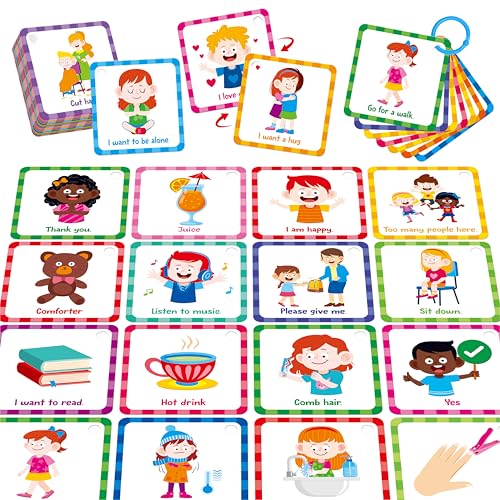
This set focuses on 80 essential communication needs across 40 double-sided cards, designed to help children and adults with autism, speech delays, or other non-verbal challenges. The bright visuals and simple text are crafted to be easily recognizable for both kids and adults, aiding in daily conversations and social interactions. It also includes a plastic ring for organization and portability, plus a drawstring pouch for storage, supporting easy practice at home or on the go.
LearnWorx 101 Baby Flash Cards

LearnWorx offers 101 first-word flashcards designed for toddlers aged 1-3, covering animals, foods, household items, outdoor objects, places, and more. The set includes on-card prompts plus reverse-side games to reinforce learning, like color identification and difference spotting. The 5″ x 3.7″ cards feature vivid illustrations intended to hold a child’s attention and promote speech recognition. The design emphasizes a balance between education and play for early literacy and language development.
ALSOLIFE PECS Communication Cards

ALSOLIFE offers 52 flash cards designed to support picture exchange and AAC for nonverbal and minimally verbal children. The cards cover seven-plus everyday situations, including routines, feelings, emergencies, and social interactions. This kit is positioned as a practical PECS and AAC resource suitable for autism and other communication needs, supporting structured exchange and gradual progression toward independent communication.
Buying Guide: Key Purchase Considerations
- Age and development stage: Choose sets that align with the child’s current communication level and cognitive load. Toddlers typically benefit from simple, bright visuals and a small number of cards that can grow over time.
- Visual clarity and consistency: Consistent artwork style and clear, straightforward labels improve recognition and reduce confusion during use with nonverbal learners.
- Durability and portability: Ring binders, waterproof materials, and compact card sizes support daily handling by caregivers and on-the-go practice.
- Flexibility for different therapies: Cards that support PECS, AAC, or general visual supports can complement speech therapy, occupational therapy, or classroom activities.
- Maintenance and organization: Look for bundles that include organizers, pouches, or retractable cords to prevent loss and simplify routine setup.
- Age range and content scope: Some sets emphasize emotions, needs, and routines; others expand vocabulary across categories. Consider a mix to cover a broader daily spectrum.
- Therapy alignment: If a child already uses a specific approach (PECS, AAC, sign language), select cards that complement that system to maximize transfer of learning.
Multiple perspectives on selecting communication cards reveal trade-offs between size, number of cards, and complexity. Larger sets offer broader vocabulary but may overwhelm a toddler at first use. Simpler, color-rich cards with straightforward icons often yield quicker, more reliable responses. Portability matters for consistent practice, while durability protects against frequent handling by young users. For caregivers and educators, choosing a core starter kit plus a few category-specific add-ons can provide a balanced, scalable approach to early communication development.