Choosing the right educational gadgets can boost curiosity, reinforce scientific thinking, and support hands-on learning across classrooms and at home. This guide highlights five carefully selected student-friendly tools that cover magnification, measurement, and practical experiments. Each pick is designed to be portable, durable, and easy to use for a range of ages and learning levels. Read on for concise product details, features, and a practical buying guide to help you compare options side-by-side.
| Product | Brand | Key Use | Image |
|---|---|---|---|
| Carson MicroBrite Plus 60x-120x Portable Microscope | Carson | Field and classroom observation |  |
| Microscope for Kids by Emarth | Emarth | Beginner science studies for kids | 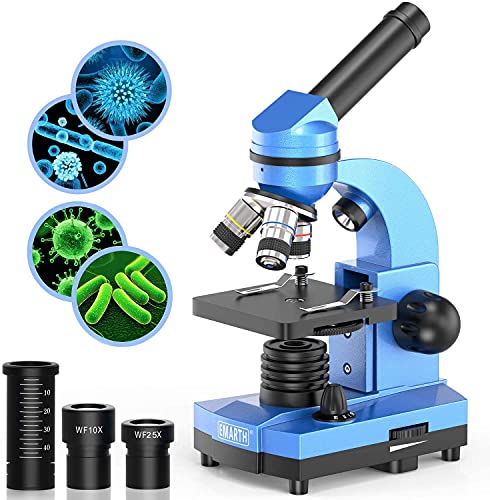 |
| Pocket Microscope by BEBANG | BEBANG | Portable biology and microbiology exploration |  |
| Pocket Scientist High School Edition | Genius Lab Gear | Geometry, measurements, and reference |  |
| The Pocket Physicist Multi-Tool | Genius Lab Gear | Physics references and quick calculations |  |
Note: The table above summarizes each product’s primary use, brand, and a quick visual reference. All items are designed for educational purposes and emphasize hands-on exploration and quick access to essential information.
Carson MicroBrite Plus 60x-120x Microscope
The Carson MicroBrite Plus is a compact, LED-lit pocket microscope designed for portability and classroom use. With 60x to 120x optical magnification, it provides accurate visual detail for examining slides, leaf surfaces, and insect parts. Its small size makes it ideal for field trips or science kits in a student lab. Education-focused features include a clear optical path, durable construction, and simple operation that suits beginners and more confident students alike. Ideal for teachers seeking a quick, reliable magnifier for science demonstrations and independent investigations.
Emarth Microscope For Kids Beginners
This Emarth microscope is designed for budding scientists: a beginner-friendly compound microscope with multiple magnification levels (40x to 1000x) and a straightforward focusing mechanism. It includes dual illumination (top and bottom) to view opaque and translucent specimens clearly. The device emphasizes safety and ease of use, making it suitable for home science projects, classrooms, and after-school programs. The kit’s accessible controls support early learners in building confidence with microscopy while enabling more advanced students to explore more challenging samples.
BEBANG Pocket Microscope
The BEBANG pocket microscope provides a simple, portable option for quick observations. With 60x-120x magnification and built-in LED lighting, it helps students examine tiny specimens in real time. It is compact enough to fit in a pocket or science kit, making it a practical tool for field observations, in-class demonstrations, and STEM exploration outside the classroom. The included slides expand its immediate usability for curious learners who want to compare samples like pond water, plant tissues, or fabric fibers.
Pocket Scientist High School Edition
The Pocket Scientist is a stainless steel, laser-etched multitool designed for teens and college students. It combines precision rulers, a protractor, and a compass with essential equations and unit conversions. This compact gadget supports geometry, physics problem-solving, and lab planning, making it a versatile addition to any student’s toolkit. Its durability and portable design make it suitable for classroom demonstrations, field measurements, and DIY science projects where quick references are valuable.
Pocket Physicist Multitool
The Pocket Physicist is another compact tool from Genius Lab Gear designed for quick reference in physics and STEM coursework. It features a straight-edge ruler, a protractor, and a compass, with metric and imperial units, plus essential constants printed on the surface. Students can sketch diagrams, measure angles, and perform quick conversions during lab sessions or problem sets. The card-like format fits easily into pockets or notebooks, promoting on-the-spot accuracy and efficient study routines.
Buying Guide: Key Purchase Considerations
- Age and skill level: Choose magnification and features that align with the learner’s current grade and curiosity. For younger students, simpler models with clear, safe operation are ideal; older students may benefit from higher magnification and more advanced reference tools.
- Portability and durability: For fieldwork and classroom use, select compact, rugged designs with protective cases or sturdy materials to withstand daily handling.
- Illumination and clarity: Good lighting improves observation quality. Dual illumination (top and bottom) is advantageous for examining both opaque and transparent samples.
- Educational value: Prefer tools that combine practical exploration with quick-reference information, such as built-in constants, unit conversions, or geometry aids that support problem-solving tasks.
- Memory and donation considerations: If sharing devices across a class, ensure that models offer consistent performance and simple setup to minimize downtime.
- Safety features: For younger users, safety comes first—look for tools with blunt edges, no sharp points, and clear ergonomics to minimize risk during use.
- Compatibility with curricula: Some gadgets pair well with science kits, lab activities, and project-based learning. Check for included manuals or recommended activities aligned with common standards.
Overall, the selected gadgets emphasize hands-on exploration, accessibility, and practical learning. When compared by magnification range, ease of use, and the breadth of included educational content, these five picks offer a well-rounded toolkit for students pursuing STEM curiosity across science, technology, engineering, and mathematics.