Choosing the right emotion flashcards helps toddlers name feelings, regulate impulses, and communicate needs. This article highlights five top sets that balance engaging illustrations, practical coping tips, and durable construction for daily classroom or at-home use. Each option supports early social-emotional learning (SEL) with age-appropriate design and kid-friendly language, making it easier for little ones to recognize, label, and manage a range of emotions.
| Product | Brand |
|---|---|
| Samma Sati Emotion Flashcards | Samma Sati |
| Emotions Flashcards (50) | SpriteGru |
| Lachilly Emotions Flashcards | Lachilly |
| Learning Resources Feelings & Emotions Puzzle Cards | Learning Resources |
| Broytain Emotions Learning Flashcards | Broytain |
Samma Sati Emotion Flashcards — 25 Cards
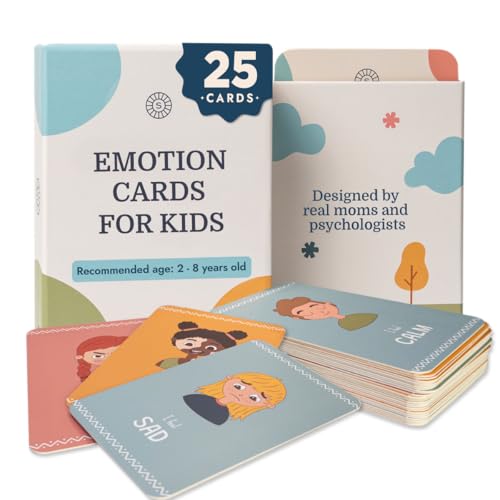
The Samma Sati set offers 25 colorfully illustrated emotion cards designed to help toddlers identify a range of feelings, from happiness to sadness and beyond. The large, expressive faces encourage quick recognition and vocabulary development, making it a versatile tool for home practice or group activities in early education settings.
Designed with safety and durability in mind, the cards feature thick cardstock and rounded corners to withstand toddler handling. This build supports ongoing use, reducing wear during daily emotion lessons. The deck’s vibrant illustrations and concise emotion labels help caregivers model language for self-expression and social awareness.
Parents and teachers can pair these cards with guided prompts like “What would you do if you felt this way?” to cultivate empathy, articulation, and self-regulation. The compact deck is easy to carry between rooms or classrooms, facilitating quick, structured SEL moments throughout the day.
Emotions Flashcards — 50 Feelings

This two-sided set covers 50 different emotions with expressive cartoon faces and a coping-skills page on the flip side. The double-sided design supports quick identification on one side and practical strategies on the other, helping kids connect feelings with actionable calm-down techniques.
The broad range of moods—including happiness, sadness, surprise, anger, fear, and embarrassment—helps children broaden emotional literacy and build empathy for others. The engaging artwork captures attention, supporting memory retention as kids label emotions during storytelling, role-play, or therapy sessions.
In practice, educators can create matching games or quick “feels checks” throughout the day to reinforce recognition. The coping-skills prompts provide a ready-to-use framework for guiding children toward healthy responses, supporting self-regulation in a friendly, approachable way.
Lachilly Emotions Learning Flashcards

The Lachilly set features 28 high-frequency emotion words paired with cute cartoon imagery. The double-sided design reduces the number of cards needed while extending learning opportunities for toddlers to connect words with feelings.
Targeted for kindergarten and early primary learners, these flashcards help expand vocabulary critical for reading and writing readiness. The bright visuals support memory recall, while the compact format allows for easy classroom activities, home practice, or travel learning sessions.
Educators can structure activities that combine word recognition with sentence frames like “I feel ___ when ___,” promoting both language development and emotional understanding. These cards are suitable for preschoolers, toddlers, and home-schooling contexts seeking a practical SEL resource.
Learning Resources Feelings & Emotions Puzzle Cards

These SEL puzzle cards combine emotion identification with a matching-game mechanic to boost cognitive skills and emotional regulation. Children match feeling cards to real-life image scenarios, reinforcing the connection between facial expressions and contexts.
Designed for ages 3+, the puzzle shapes introduce a gentle challenge that supports critical thinking and problem-solving in addition to emotional literacy. The colorfully illustrated scenes maintain engagement, helping children stay focused during guided play or structured therapy sessions.
The resource also doubles as a classroom tool for group activities, encouraging turn-taking and collaborative learning while teaching essential coping strategies in a child-friendly format.
Broytain Emotions Learning Flashcards — 26 Cards

Broytain combines 26 emotion cards with a built-in mirror on each card, encouraging self-recognition of facial expressions. The reflective feature helps toddlers connect expressions with their own emotions, a practical step in developing self-awareness and communication.
The back of each card includes simple coping suggestions like deep breathing, asking for help, or taking a break. This pairing of emotion labels and actionable strategies supports practical emotional management for young children at home and in early-education settings.
Alphabetized elements on the cards promote early literacy alongside SEL, making the deck a versatile classroom and therapy resource for toddlers, preschoolers, and early readers navigating social interactions and emotional challenges.
Buying Guide: Key Purchase Considerations And Comparisons
Age-appropriateness and durability are essential when choosing emotion flashcards for toddlers. Look for thick cardstock, rounded corners, and a compact size that holds up to frequent handling and rough play. Double-sided cards add value by combining emotion labels with coping strategies, such as breathing techniques or simple actions, helping children translate feelings into actions.
Visual design matters. Bright, high-contrast colors with clear facial expressions improve recognition and memory. Avoid overly complex images that may confuse beginners. Picture-forward decks that pair a word with a corresponding image support vocabulary expansion and reading readiness.
Edition features to consider include built-in mirrors for self-observation (as seen in Broytain), puzzle formats for cognitive integration, and small group activities that reinforce social skills like turn-taking and empathy. Some sets emphasize coping strategies directly on the back of each card; others focus on a larger number of moods for broader coverage.
Therapy and classroom applicability varies. Sets used by speech-language pathologists or occupational therapists often include practical prompts or structured activities. For homeschooling, choose decks that include activity ideas, teacher tips, or printable extensions to maximize learning time and engagement.
Pricing and value should be weighed against scope and durability. A larger deck might deliver more variety, but a compact set can be more practical for quick daily SEL sessions. Finally, consider whether you want one-language focus or broader coping skills, and select a set that aligns with your child’s needs and your teaching style.