Parents and educators increasingly seek engaging, educational tools that blend play with practical engineering concepts. The following selection highlights five top-rated kits that foster problem-solving, fine motor skills, and foundational mechanical thinking. Each kit offers hands-on building experiences, safety features, and age-appropriate challenges.
| Product | Brand | Key Focus | Age Range |
|---|---|---|---|
| Thames & Kosmos Kids First: Intro to Tools & Building | Thames & Kosmos | Basic tools, six models | 3+ |
| Educational Insights Design & Drill Robot Workshop | Educational Insights | Robot building, real electric drill | 3+ |
| Educational Insights Design & Drill Gears Workshop | Educational Insights | Gear mechanisms, interactive builds | 3+ |
| KIDWILL Kids Tool Set with Electric Drill | KIDWILL | Pretend play with working drill | 3-5 |
| Take-Apart Electric Building Toys Car | DICROON | Take-apart designs, motorized drill | 3+ |
Note: The collection below focuses on five diverse kits that balance traditional tool play with budding engineering concepts, ensuring a wide range of interests and project types.
Thames & Kosmos Kids First: Intro to Tools & Building

This introductory STEM kit introduces preschoolers to basic construction tools and mechanical concepts. It features six kid-friendly models, including a workbench, race car, airplane, house, scissors, and toolbox. The set emphasizes safe handling of tools like a hammer, screwdriver, and wrench, helping young learners connect hands-on activities with foundational engineering principles. The larger, durable plastic pieces are designed for small hands and safe manipulation, making it a solid first step into DIY construction and early mechanical thinking.
Educational Insights Design & Drill Robot Workshop

This robot workshop combines construction play with real tool experience. With over 70 pieces, children practice fine motor skills while assembling custom robots. The kit introduces early STEM concepts such as basic mechanism design and problem-solving as kids connect parts, drive with a real electric drill, and experiment with different configurations. It supports unplugged play and encourages experimentation, making it a strong choice for developing early engineering habits.
Educational Insights Design & Drill Gears Workshop

This kit focuses on gears and motion, letting children drill bolts into the board to match designs and then activate a spinning mechanism. The included working drill supports a tangible understanding of cause and effect, rotation, and mechanical timing. It also fosters fine motor precision as kids align pieces, tighten bolts, and observe how gear interactions drive movement in their models.
KIDWILL Kids Tool Set with Electric Drill

This Montessori-inspired set blends pretend play with real-world tool experiences. It includes a working drill among other kid-sized tools, promoting color and shape recognition, counting, and fine motor skills. The kit is designed for ages 3-5 and emphasizes safe handling through rounded edges and non-toxic finishes. The addition of stickers provides a creative customization element, enhancing engagement and imaginative play while building foundational engineering confidence.
Take-Apart Electric Building Toys Car
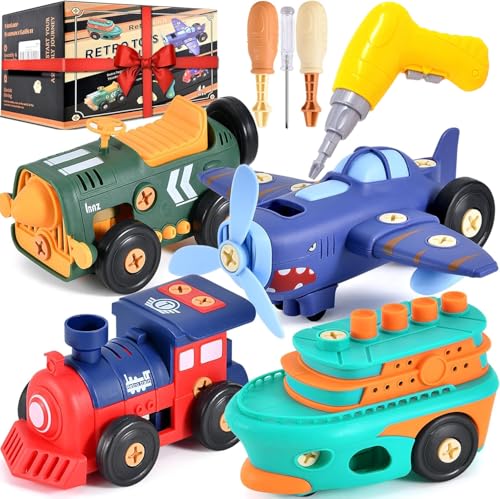
This take-apart set invites kids to disassemble and reassemble vehicles, offering four designs: airplane, ship, train, and car. An electric drill and motor enable simple repairs and rebuilds, reinforcing problem-solving and engineering concepts. Crafted from durable, BPA-free ABS plastic, the toy prioritizes safety and long-lasting use. The interactive nature makes it a strong choice for developing cognitive skills, hand-eye coordination, and early mechanical reasoning.
Buying Guide: Key Purchase Considerations
- Age appropriateness: Look for kits labeled 3+ or 5+ to match your child’s developmental stage and ensure safe handling of tools and small parts.
- Safety features: Prioritize non-toxic materials, rounded edges, and parental supervision recommendations. Check for certifications and lab-tested materials where available.
- Hands-on vs. guided learning: Some sets emphasize open-ended building, while others provide structured steps. Consider your child’s learning style and supervision level.
- Skill progression: Start with basic models and gradually introduce more complex mechanisms such as gears, bolts, and take-apart assemblies to build confidence.
- Tool realism vs. pretend play: Realistic working tools can enhance technical interest, but ensure they’re age-appropriate and safe for young learners.
- Expandability: Choose kits that offer additional accessories or compatible parts to extend learning as interests grow.
- Storage and organization: Containers and included boxes help keep pieces organized, supporting independent play and reducing loss risk.
- Learning outcomes: Seek kits that explicitly teach engineering concepts such as simple machines, circuitry basics, or motion through practical activities.
Across these options, parents can select kits that balance creativity with technical foundations. Each product emphasizes different aspects of engineering—from tool handling and basic construction to take-apart mechanics and gear-driven motion—providing a well-rounded start to young learners’ engineering journeys.