Parents and educators seeking effective learning aids for autistic children can turn to structured flash cards that support speech development, visual cues, and independence. This article highlights five carefully selected options designed to aid communication, reduce frustration, and encourage interaction through engaging visuals and simple cues.
| Product | Brand | Key Benefit |
|---|---|---|
| Aullsaty Toddler Talking Flash Cards (B0C7VSZDSG) | Aullsaty | 248 sight words; Montessori-inspired speech therapy |
| Plastic Communication Cards For Non Verbal Children (B0DWZFD8BP) | Hidaya Prints | 70 picture words; portable ring binder |
| Special Needs My Communication Cards (B08CFNDHYY) | Amonev | 27 visual cue flash cards for conversation prompts |
| CHEFAN 120 PCS Autism Communication Cards (B0CLD19W3X) | CHEFAN | 120 cards; 3 themes; strong daily-use cues |
| ZONSTVYS Talking Flash Cards (B0FL18L9VP) | ZONSTVYS | 510 sight words across 255 double-sided cards; 2-in-1 tablet |
Below are five product profiles chosen for accessibility, clear visuals, and practical use in autism-focused speech and language development activities. Each section includes a direct link to Amazon for quick access.
Aullsaty Talking Flash Cards With 248 Sight Words

The Aullsaty flash cards blend Montessori-inspired learning with engaging sound play. A cute cat card reader activates words across 14 subjects, including animals, vehicles, letters, and numbers. With 248 sight words and a standard American accent, the system supports early vocabulary growth and basic sentence framing. The device offers adjustable volume (up to five levels) and a repeat function to reinforce pronunciation, making it a practical tool for in-home practice or therapy sessions.
Plastic Communication Cards For Non Verbal Children

This ring-binder set offers 30 double-sided picture cards (60 words) to support clear daily communication. Sized for portability, these visuals help nonverbal individuals express needs and feelings in real time. The simple format is suitable for on-the-go use and family interactions, with emphasis on practical everyday scenarios, making it a versatile visual aid for autism support and speech development activities.
Special Needs My Communication Cards For Special Ed
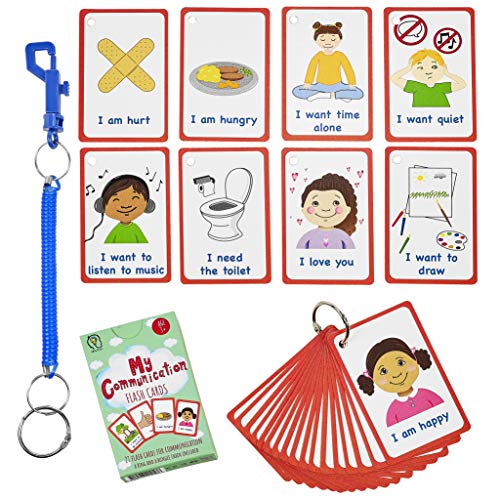
Amonev’s set focuses on language development through simple, illustrated flash cards. It emphasizes reducing anxiety and building confidence by using pictorial cues to support quick recognition and expressive attempts. The cards are designed to be approachable for both nonverbal learners and those with speech delays, offering a straightforward, low-stress way to expand conversational readiness in everyday contexts.
CHEFAN 120 PCS Autism Communication Cards

CHEFAN offers a large set of 120 visual cue cards designed for autism therapy, speech delay support, and special education. The kit includes themes that cover emotions and daily routines, aiding nonverbal and minimally verbal individuals in expressing needs and states. Each card’s vivid imagery is paired with clear text, and a plastic buckle and flip rings help keep resources organized and accessible for therapy sessions or classroom use.
ZONSTVYS 2-in-1 Talking Flash Cards And Tablet

ZONSTVYS blends traditional flash cards with a 7-inch LCD writing tablet, creating a dual learning platform. With 510 sight words across 255 double-sided cards, it covers a wide range of topics—from animals to foods—and includes a “speak and spell” feature. The tablet enables doodling and expressive drawing, supporting fine motor skills and creative engagement while reinforcing vocabulary acquisition, making it a multifaceted tool for early language development and therapy extensions.
Buying Guide: Key Considerations For Choosing Flash Cards For Autistic Children
- Communication goals: Determine whether the cards focus on everyday needs, emotions, or vocabulary expansion. Choose sets that align with current learning objectives and therapy plans.
- Visual clarity and design: Look for high-contrast images, simple illustrations, and consistent labeling to minimize cognitive overload and support recognition.
- Customization and expandability: Some products offer additional cards, rings, or modules. Consider future growth and whether the set can be augmented as skills advance.
- Durability and portability: For daily use at home or school, cards should withstand frequent handling. Ring binders and buckles help prevent loss and keep sets organized.
- Auditory support: Audio features can reinforce pronunciation and listening skills. Check volume controls and language options to match the learner’s needs.
- Engagement and motivation: Fun themes, relatable characters, and interactive readers can sustain interest. Ensure the design resonates with the child’s preferences.
- Safety and age suitability: Confirm non-toxic materials, appropriate sizing, and age guidance, especially for younger children.
- Family and caregiver involvement: Choose sets that encourage joint interaction—benefits include modeling language use and guided practice during family activities.
Across these options, the best choice depends on whether the focus is rapid practical communication, broad vocabulary development, or an integrated learning experience combining a tablet or reader with visual cues. Each product offers distinct strengths, enabling caregivers to tailor approaches to the child’s communication readiness and environment.