Choosing the right gas-powered dirt bike for a 12-year-old involves balancing safety, ease of use, and growing rider confidence. The models below emphasize beginner-friendly starting systems, predictable power, reliable brakes, and sturdy frames tailored for younger riders who are still learning proper riding techniques. Each option includes a kid-friendly top speed, safety features, and simple maintenance to keep learning on track.
| Product | Engine | Top Speed | Weight Capacity | URL |
|---|---|---|---|---|
| FRP FX40-Ogemaw Red | 40cc 4-Stroke | 20 MPH | 132 lbs | Link |
| FRP FX40-Ogemaw Black | 40cc 4-Stroke | 20 MPH | 132 lbs | Link |
| FRP GMB100 Mini Dirt Bike 99cc | 99cc 4-Stroke | Up to 28 MPH | 220 lbs | Link |
| FRP Mini Dirt Bike GMB100 (Black) | 99cc 4-Stroke | Up to 28 MPH | 220 lbs | Link |
| Reheyre 49cc Dirt Bike | 49cc 2-Stroke | ≈25 MPH | Covers typical rider range | Link |
Summary: The FRP FX40 series provides beginner-friendly 40cc engines with easy pull starts and front/rear disc brakes, ideal for early learning. The FRP GMB100 line upgrades power with a 99cc four-stroke engine, maintaining no oil mixing and practical speed. Reheyre’s 49cc option offers a lighter but solid 2-stroke entry with dual discs for reliable brakes. Together, these picks cover safety, maintenance simplicity, and age-appropriate performance for a 12-year-old taking their first steps into off-road riding.
FRP FX40-Ogemaw Red: Beginner Power & Safe Handling

The FRP FX40-Ogemaw combines a manageable 40cc four-stroke engine with a one-pull starting system, simplifying ignition for younger riders. Its top speed of 20 MPH provides enough momentum for skill-building without becoming overwhelming. A robust safety system includes front and rear disc brakes to ensure confident stopping power, while the sturdy suspension helps absorb rough terrain common on beginner trails. This model’s design emphasizes easy maintenance and consistent performance, making it a practical first dirt bike for a 12-year-old just learning throttle control and body positioning.
FRP FX40-Ogemaw Black: Safe Start, Clear Limits
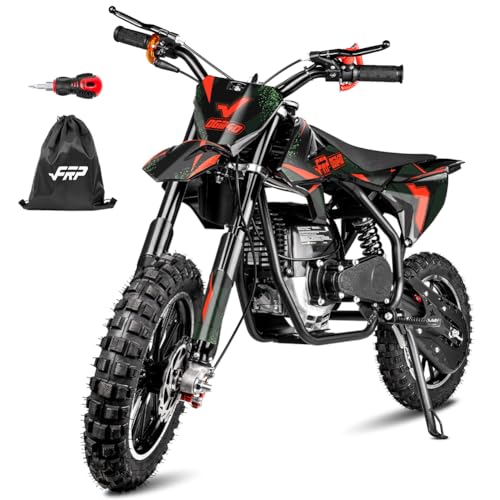
This black variant mirrors the red model’s beginner-friendly design, offering a reliable one-pull start and a controllable 20 MPH top speed. The 40cc four-stroke engine simplifies fuel management and reduces maintenance compared to two-stroke counterparts because no oil mixing is required. The combination of responsive brakes, cushioned suspension, and a durable frame makes it well-suited for a 12-year-old moving from casual riding to more advanced techniques, such as cornering and throttle modulation on varied terrains.
FRP GMB100 Mini Dirt Bike 99cc: More Power For Growth

Powered by a 99cc four-stroke engine, this FRP model increases available power while retaining features beneficial to beginners, such as no oil mixing and an easy-start pull mechanism. The bike reaches speeds up to 28 MPH, which supports gradual progression as the rider gains confidence. Added conveniences include a front light for low-light rides and a protective neck gaiter. The bike’s weight capacity (up to 220 lbs) supports older siblings or growth spurts, helping families avoid frequent model changes as riders mature.
FRP Mini Dirt Bike GMB100 Black: Stable Entry-Level Power

This GMB100 variant emphasizes a straightforward, dependable ride with a 99cc engine and a similar 28 MPH ceiling as its red sibling. In addition to no oil mixing, riders benefit from a single-pull start and a design that tolerates mixed-terrain use. The dual-disc braking system enhances control during sudden stops, and the headlight/neck gaiter pairing adds visibility and protection for rides that extend into dusk or dusty trails. Suitable for riders aged 13 and up, it remains a practical step-up for motivated 12-year-olds seeking more capability while maintaining safety margins.
Reheyre 49cc Dirt Bike: Compact Starter With Brakes

The Reheyre 49cc dirt bike provides a lighter, more approachable entry into off-road riding with a 25:1 gas-oil mix required two-stroke engine delivering up to about 25 MPH. Dual front and rear disc brakes offer solid stopping power, aiding new riders who are learning to modulate speed and braking in varied terrain. The bike’s lighter weight and robust construction are advantageous for younger riders transitioning from balance-focused riding to throttle management, while the 10-inch all-terrain tires help maintain traction on dirt trails and gravel surfaces.
Buying Guide: Key Purchase Considerations
Engine size and power delivery: For beginners, a smaller displacement (40cc to 99cc) with a predictable, controllable throttle helps build confidence. Four-stroke engines are generally friendlier to new riders because they require less maintenance and don’t require oil mixing.
Starting system and ease of use: A one-pull start or simple kick-start mechanism reduces frustration for young riders who are still learning body positioning and balance. Look for models with straightforward maintenance and readily available replacement parts.
Braking and suspension: Front and rear disc brakes provide reliable stopping power, which is essential for safety in trails and fields. Adequate suspension helps absorb bumps and keeps the rider stable, especially on uneven ground.
Weight capacity and rider height: Choose a bike with a weight limit that accommodates growth. A bit of extra capacity helps a rider progress without needing a new bike too soon, while ensuring the frame remains sturdy for safety.
Maintenance and fuel considerations: Four-stroke engines typically require less frequent maintenance and no oil mixing, which simplifies routine checks. Consider fuel efficiency, gas availability, and ease of performing basic maintenance at home.
Age-appropriate features: Features such as headlights for visibility, neck gaiters for protection, and basic protective gear compatibility should guide selection. For riders around 12 years old, consider a model that enables stepping into more complex riding techniques over time.
Durability and value: A well-built frame, quality brakes, and reliable components help extend the bike’s life and reduce total cost of ownership. Compare warranty terms and availability of local service when evaluating options.
Trail suitability and local rules: Check local laws and terrain where the bike will be used. Some areas require specific engine sizes or noise levels, and proper protective gear should always accompany use on public trails.
Safety equipment: Invest in a certified helmet, gloves, knee and elbow pads, and protective apparel. Training on safe starting, braking, and cornering techniques complements the bike’s built-in safety features.
Summary of considerations: For most 12-year-olds just beginning off-road riding, a 40cc to 99cc four-stroke with a simple starting mechanism, front and rear disc brakes, and a modest top speed offers a balanced, safe path to skill development. As riding proficiency grows, families can evaluate higher-displacement options that remain within safety and local regulations.