Introducing young children to music can foster rhythm, coordination, and creativity. The following hand-picked toy guitars are designed for four-year-olds, emphasizing safety, age-appropriate play, and engaging features like lights, sounds, and strap-adjustable designs. Each option below offers a different blend of realism, durability, and educational play for small hands. This guide highlights five suitable picks, summarizing key traits to help caregivers choose a kid-friendly instrument that supports early musical exploration.
| Product | Brand | Type | Key Feature | Age Range |
|---|---|---|---|---|
| Kids Electric Toy Guitar with Strap (Blue) | Jakeloo | Electric Toy Guitar | Built-in demos, lights, infrared interactivity | 3-6 |
| 2-in-1 Electric Guitar With Piano Mode | Drmukie | Turquoise 2-in-1 Gift | Piano and guitar sounds with lights | 3-5 |
| 21 Inch Wooden Acoustic Guitar | Jakeloo | Wooden Acoustic | Four strings, natural wood sound | 3-9 |
| Raimy 21in Ukulele Guitar | Raimy | Ukulele/ Guitar Style | Authentic sound, kid-friendly size | 3-7 |
| M SANMERSEN Pink Electric Toy Guitar | M SANMERSEN | Electric Toy Guitar | 8 demos, infrared lights, no-strings design | 3-5 |
Jakeloo Kids Toddler Electric Toy Guitar (Blue)
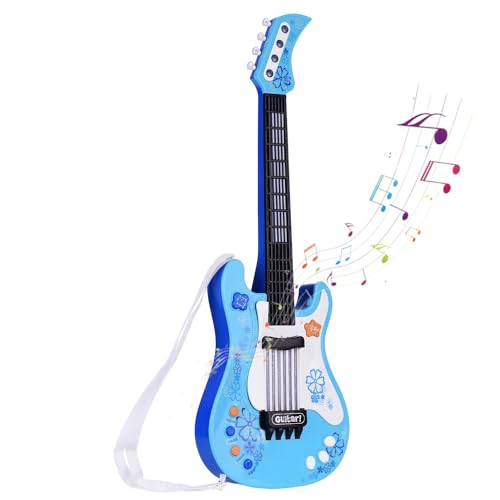
The Jakeloo electric toy guitar is designed for small players, featuring a child-safe ABS body and a no-string design to reduce pinching risks. It offers built-in music in the form of 8 demos, 4 animal sounds, and 4 tones plus 4 rhythms. An infrared sensing system with light-up bars and 3 instrument sounds supports interactive play, encouraging kids to explore rhythm and melody while developing hand-eye coordination. The strap and compact size make it portable for travel or classroom settings, helping children feel engaged as soon as they pick it up.
Safety and development considerations include durable, drop-resistant construction and a design that minimizes choking hazards. The bundled features aim to foster early musical curiosity, broadening a child’s sensory experiences through synchronized light cues and simple, repeatable tunes.
Drmukie Kids 2-in-1 Guitar With Piano Mode

This multifunctional toy blends guitar and piano modes, delivering 8 famous piano songs, 8 guitar tunes, 4 children’s songs, and 4 instrument sounds. It also includes 2 dynamic rhythms and 2 animal songs, offering a varied sonic palette for children ages 3 to 5. Interactive infrared lights respond to touch, with colored lights dancing to every press of keys or strum, which can support visual tracking and motor coordination. The portable, strap-adjustable design makes it easy for kids to take the instrument on the go, promoting independent exploration of different musical styles.
In terms of developmental value, the toy supports auditory learning and rhythm recognition while strengthening fine motor skills. It is intended to be a glad, engaging entry point into music without the complexity of adult instruments, providing a safe bridge from play to more serious musical study later on.
Jakeloo 21 Inch Wooden Acoustic Guitar

This wooden acoustic guitar offers a more traditional look with four plastic strings and a sturdy wooden body. Its longer scale and comfortable grip support developing motor skills and finger positioning, while a gliding fret layout helps children learn basic chords and scale recognition. The natural wood finish provides a sensory experience closer to real instruments, which can foster an early appreciation for acoustic sound quality as children explore different tones and volumes with light strumming.
Durability and safety considerations emphasize a coating designed to protect fingers and reduce risk of splinters, making it suitable for supervised play. This option balances educational value with a more realistic instrument experience, helping children differentiate between toy sounds and real-life guitar tones.
Raimy 21-Inch Ukulele Guitar for Kids

Raimy’s 21-inch ukulele-style guitar is sized for small hands, offering an authentic-sounding play experience that feels substantial without overwhelming beginners. The design emphasizes safety and durability, using child-friendly materials to ensure lasting play. Although marketed as a ukulele-inspired instrument, its tuning and string arrangement aim to deliver a true-sounding musical experience appropriate for a child’s first instrument. The compact dimensions help with comfortable hand positioning and easier chord transitions during practice sessions or playful jam times.
Educational merit includes cultivating rhythm, pitch recognition, and basic strumming technique, giving children a tangible entry point into music theory while keeping playtime approachable and enjoyable.
M SANMERSEN Pink Electric Toy Guitar

This pink electric toy guitar is built for early rock-star dreams with 8 demo songs, 4 instrument tones, and 4 rhythms. Its infrared sensing system drives light displays through 6 colorful tubes and 4 flashing lights that respond to touch, offering an engaging sensory experience. The no-string design reduces finger pinching, which is a safety asset for preschoolers, while the durable ABS construction supports daily use. The strap makes it easy to carry, promoting active play and movement while children experiment with different musical patterns and tempos.
From a developmental perspective, the instrument supports rhythm development, auditory discrimination, and creativity. The lively audio-visual feedback can sustain attention and encourage repeated practice, making it a reliable option for children who enjoy interactive, performative play.
Buying Guide: Key Purchase Considerations And Comparisons
- Age appropriateness: Look for instruments labeled for ages 3–5 or 3–7 with gentle complexity. Toys should avoid small detachable parts and sharp edges.
- Safety and materials: Prioritize no-toxic plastics or wood with smooth edges. No-string designs reduce pinching risks; ensure durable construction to withstand drops and rough handling.
- Educational value: Consider whether the instrument supports rhythm development, pitch recognition, and fine motor skills. Toys with built-in demos, light cues, and multiple modes offer varied learning pathways.
- Portability and ease of use: Strap-adjustable designs and light weight help kids carry the instrument independently, promoting independent play and social sharing.
- Sound quality vs. toy status: Some options lean toward realistic instrument sounds (wooden or acoustic shapes), while others emphasize bright, catchy toy tones. Choose based on a child’s interest—realistic sound can spur longer-term curiosity; playful tones can boost early engagement.
- Durability and maintenance: Look for impact-resistant bodies and easily cleanable surfaces. Materials like ABS plastic are common in durable toy guitars; wooden options offer more traditional aesthetics but may require more care.
- Learning trajectory: If a child shows early interest, consider stepping up to slightly more challenging instruments later. A mix of instrument types (ukulele, toy guitar, piano mode) can broaden musical exposure without overwhelming a beginner.
- Value and longevity: Multi-instrument sets (7-piece kits, 2-in-1 modes) provide extended play value, helping justify the purchase as a growing child’s first music toolkit.