For young explorers, a well-chosen lab kit can turn science from a subject into an adventure. The following selections focus on engaging experiments, safety-friendly tools, and clear instructions to support independent discovery. Whether kids are drawn to chemistry, earth science, or general STEM activities, these kits offer hands-on learning that aligns with curiosity and developmental needs.
| Product | Brand | Overview |
|---|---|---|
| National Geographic Junior Chemistry Set | Blue Marble | 50 experiments, beginner-friendly, focuses on basic chemistry with common household items |
| National Geographic Mega Science Lab | Blue Marble | 75 experiments across earth science, chemistry, and STEM magic projects |
| UNGLINGA 150 Experiments Science Kits | UNGLINGA | Large variety, includes many topics and kid-friendly tools |
| UNGLINGA 70 Lab Experiments | UNGLINGA | Multiple experiments, clear illustrated guide, STEM focus |
| National Geographic Earth Science Kit | Blue Marble | Earth science activities, crystal growing, volcano, rock collection |
National Geographic Junior Chemistry Set

A complete chemistry lab designed for young scientists aged 4 and up. The kit uses common household items such as baking soda and vinegar to introduce foundational chemistry concepts in an accessible way. It includes 50 hands-on experiments and more than 20 lab tools, with illustrated, step-by-step instructions to support independent exploration.
Key items include: a beginner-friendly toolkit, safe materials, and guidance that emphasizes observation and basic measurement. This set is well-suited for early science exploration at home or in classroom-style settings, promoting curiosity while reinforcing safety and procedural thinking.
National Geographic Mega Science Lab
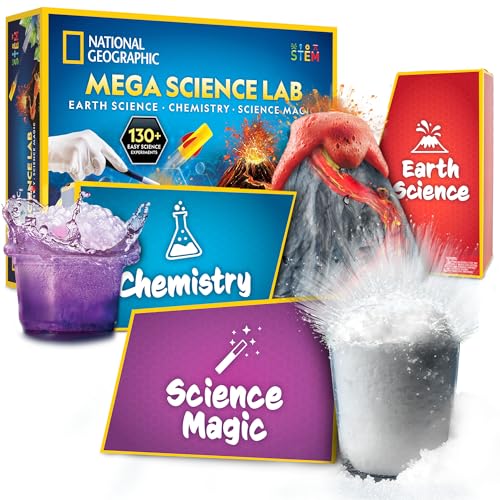
This all-in-one science kit covers earth science, chemistry, and science magic with 75 experiments, plus a bonus guide featuring 30 additional activities. Kids can build volcanoes, grow crystals, create water tornadoes, and collect real rock and mineral specimens. The chemistry experiments in this kit let children explore goo, gas reactions, and other engaging chemical processes as part of a broader science exploration experience.
UNGLINGA 150 Experiments Science Kits

This kit provides a broad collection of experiments across earth science, chemistry, and physics to engage a wide range of interests. Each activity is described with a well-illustrated, step-by-step manual, making it easy for children to follow along. Materials are selected to be kid-friendly, and many projects use common household items, encouraging at-home learning and experimentation.
UNGLINGA 70 Lab Experiments

This varied science kit emphasizes critical thinking and problem solving through 70 experiments. Projects include volcanoes, crystal growth, fruit circuits, and chemical reactions. The included manual provides clear instructions and scientific insights, helping kids understand the science behind the activities while encouraging curiosity and hands-on practice.
National Geographic Earth Science Kit

Designed to expand knowledge in earth sciences, this kit offers 15+ experiments, including volcano activities, crystal growth, and geological digs. The included learning guide helps connect experiments to core concepts in geology, ecology, and meteorology, making it a solid option for family STEM time and group learning experiences.
Discovery Super Reactions Science Kit

Although not requested as one of the five, this section provides context for expansion choices. The Discovery kit features 66 experiments, including guided activities and bonus DIY ideas. It emphasizes real chemistry concepts, such as acid-base reactions and gas expansion, through hands-on experiments that are appropriate for curious, older children.
Buying Guide: Key Purchase Considerations
- Age appropriateness: Choose kits aligned with the child’s developmental stage and reading level. Some kits are designed for ages as young as 4, while others target older kids with more complex experiments.
- Safety and materials: Look for kits that use child-safe, non-toxic materials and come with protective gear like goggles or gloves when appropriate. Check for clearly labeled safety instructions and parental supervision notes.
- Scope and variety: Consider whether a kit offers a broad range of topics (chemistry, earth science, physics) or is focused on a single domain. A mix is ideal for sustained engagement.
- Instruction quality: Illustrated, step-by-step guides help ensure independent use and reduce frustration. Clear explanations of scientific concepts add educational value.
- Reusability and expansion: Some kits include reusable tools and additional experiments, enabling long-term use and ongoing learning without frequent replacements.
- Storage and organization: A well-organized kit with a storage case or labeled components helps maintain order and safety during use.
- Value and scope: Compare the number of experiments, included tools, and additional resources (online guides, printable worksheets) to determine overall value.
- Multi-kid usability: If the kit is intended for group learning or siblings, ensure it supports collaborative activities and includes sufficient materials.
In selecting a kit, weigh curiosity-driven goals against safety and accessibility. For beginners, a kit with straightforward, illustrated directions and a broad set of activities can build confidence. For more advanced young scientists, look for kits that introduce basic lab concepts, measurement, and experimental design to foster deeper understanding over time.