This guide highlights top learning chart products designed to engage young learners and support early literacy and math skills. Each pick focuses on visual appeal, durability, and interactive features that keep kids motivated without screens. The selection spans classroom-ready wall posters, alphabet charts, reward systems, and magnetic boards to help teachers and parents reinforce daily routines and foundational concepts.
| Product | What It Offers | Best For |
|---|---|---|
| Hadley Designs 16 Educational Posters | 11×17 posters with lamination, durable cardstock, covers ABCs, calendars, maps, weather, shapes, numbers, time, emotions, and more | Classroom or homeschool decor and language skills |
| Fun Educational Posters for Toddlers 1–3 | 16 topics including shapes, emotions, letters, body parts; classroom-ready 11×17 posters | Toddler and preschool learning spaces |
| Just Smarty Alphabet Wall Chart | ABCs and 123s with engaging visuals, supports speech development and early literacy | Toddlers and early learners needing language help |
| Electronic Alphabet Wall Chart (GaHoo) | Interactive talking alphabet and numbers with sound and portability for on-the-go learning | Interactive math and literacy basics |
| Learn & Climb Reward Chart Magnetic Board | 63 chores and potty tasks with a reusable dry-erase surface for multiple kids | Behavior management and responsibility building |
Below you’ll find deeper looks at five top picks, followed by a practical buying guide to help you choose the right learning chart setup for your needs and space.
Hadley Designs 16 Educational Posters

These 11×17 classroom posters are built to withstand active learning. The 3mm laminated 100 lb cardstock enhances durability and even allows writing with dry-erase markers. The set covers essential topics like the ABCs, calendar skills, basic geography with USA and world maps, weather, shapes, numbers, time, emotions, and basic math concepts such as addition and subtraction. Designed by a pre-K teacher, the posters aim to balance visual appeal with educational depth, making it easier to integrate language, reading, and speaking activities into daily routines. They work well for distance learning or in-person instruction and are suitable for a broad age range from babies through early elementary years. The large format encourages interactive, hands-on participation without screens.
Features highlighted include waterproof and tear-resistant construction, a kid-friendly design philosophy, and a comprehensive range of topics that align with early learning standards. Teachers and homeschooling parents can pair these posters with flashcards and read-aloud activities to reinforce vocabulary and concept retention.
Fun Educational Posters for Toddlers 1–3 – 16 Posters

This set offers a lively mix of topics from shapes and emotions to letters and body parts, all designed for toddlers and preschoolers. The uniform 11×17 size makes it easy to display in small learning corners or larger walls without crowding. The posters emphasize early literacy, number sense, and social-emotional development through bright visuals and concise text. They’re ideal for classrooms, daycare centers, and homeschool spaces seeking a comprehensive, visually engaging tool that supports routine-based learning and independent exploration. The varied topics help keep daily lessons fresh and interactive.
Durability and simplicity are key: the posters are easy to mount, remove, and swap as your teaching focus shifts. Use them as a daily learning prompt, a visual schedule, or as part of a themed literacy station to boost focus and memory in young children.
Just Smarty Alphabet Wall Chart

This wall chart focuses on alphabet readiness and early literacy through interactive visuals and letter-sound connections. It supports speech development and language acquisition, making it particularly useful for toddlers and preschoolers who benefit from auditory-visual learning cues. The chart also touches on basic numbers and common words, which helps children begin to recognize patterns in language. It’s marketed as a versatile tool for therapy, classroom activities, and at-home learning, with an emphasis on engaging, music-enabled learning experiences that encourage participation and practice.
Key strengths include its age-appropriate design for 1–5-year-olds, its suitability for speech therapy contexts, and its potential to be used as a platform for singing along to educational songs. The product is a practical, low-friction way to introduce letters, sounds, and early reading routines without overwhelming young learners.
Electronic Alphabet Wall Chart (GaHoo) – Green

The GaHoo interactive wall chart combines touch-activated learning with audible prompts to teach ABCs and basic counting. The back-side content introduces shapes, colors, and counts, expanding cognitive exposure beyond letters. It’s designed for portability, allowing learning to move from classroom walls to car rides or travel spaces. The device emphasizes tactile interaction, with a speaker activated by touching the image, letter, or number rather than a dedicated button. This makes it accessible for younger children or those needing alternative interaction methods, while supporting reading readiness and number sense through multiple formats.
The tool’s audio features, clear visuals, and child-friendly design make it a flexible option for varied learning settings. It’s well-suited for short, daily practice sessions that reinforce phonics, counting, and vocabulary, with a balance of entertainment and education that can sustain engagement over time.
Learn & Climb Reward Chart Magnetic Board
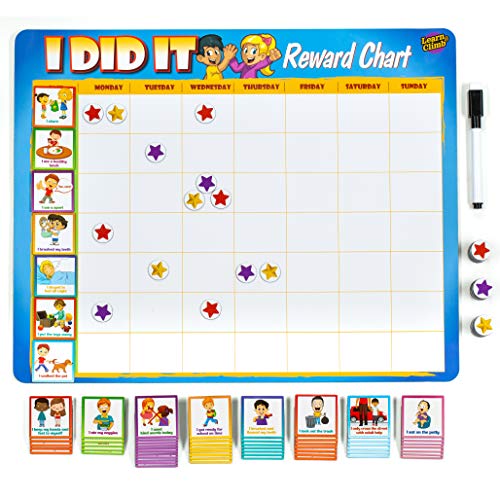
This magnetic reward chart helps parents and teachers structure routines and positive behaviors across multiple children. The 63 chore options cover a broad spectrum of responsibilities, from daily tasks to more specific goals like potty training. The reusable dry-erase surface enables customization, allowing caregivers to tailor rewards and tasks to individual kids and changing routines. Durable construction supports daily use at home or in a classroom. By visually tracking progress, children gain a concrete sense of accomplishment and accountability, which can improve motivation and consistency in behavior.
The chart’s flexibility is its strength: you can create a simple one-chart-per-child system or run a shared chart for a family or classroom. It pairs well with verbal praise and small rewards, making it an effective tool for establishing consistent routines and accountability in early learners.
Buying Guide: Key Purchase Considerations And Comparisons
- Durability and materials: For active kids, laminated posters and sturdy cardstock reduce wear. Look for waterproof or tear-resistant options for long-term use in classrooms or play areas.
- Size and layout: Standard 11×17 posters fit most space configurations and work well for group displays. Consider wall space and the number of topics you want visible at once.
- Interactivity level: Interactive boards and talking charts can boost engagement, especially for language development and early literacy. Portability may matter for cars, trips, or flexible classrooms.
- Scope of content: Ensure topics align with your learning goals—alphabet and numbers basics, shapes, calendars, emotions, and daily routines. A broader set supports a comprehensive early-learning environment.
- Multi-child suitability: If you have multiple children, consider magnetic or reusable charts that allow individualized tracking without clutter.
- Therapy and special needs compatibility: Some products emphasize speech and language development and can serve as useful tools in therapy, autism-friendly learning, and sensory-friendly setups.
- Visual design and accessibility: Bold colors, large lettering, and clear icons help maintain attention and aid recognition for early learners.
- Ease of use and maintenance: Reusable surfaces, dry-erase compatibility, and easy cleaning are practical for busy households and classrooms alike.
When choosing, weigh your space, your child’s learning goals, and whether you prefer a fixed wall display or a flexible, reusable system. A combination approach—using posters for foundational concepts and a reward or chart system for daily routines—often yields balanced results. This mix supports independent exploration, routine-building, and targeted skill practice across reading, writing, and math foundations.