Choosing the right math manipulatives helps young learners build solid number sense, counting fluency, and early operations. This guide highlights five engaging options that work well in classrooms, homeschools, or tutoring sessions. Each product offers hands-on learning, colorful design, and activities to support different math standards. From counting cubes to base-ten blocks, these tools encourage exploration, patterning, and problem-solving in a playful way that aligns with core math skills.
| Product | Key Benefit | Best For |
|---|---|---|
| Learning Resources MathLink Cubes (Set of 100) | Number sense, counting to 100, patterns, and basic operations | Early elementary and homeschool |
| Learning Resources Math Island Addition & Subtraction Game | Two-number practice with dice and operations in a game format | Motivating math games |
| Learning Resources MathLink Cubes Big Builders | Patterning, counting, and counting-to-100 with building blocks | Creative math building |
| SpriteGru Math Linking Cubes | Colorful, linked cubes with activity cards for guided practice | Small-group or centers |
| TOMMYHOME Base Ten Blocks With Place Value Chart | Place value understanding and multi-digit counting | Foundational arithmetic |
Learning Resources MathLink Cubes – Set of 100

These MathLink Cubes provide 100 colored cubes that snap together on all sides, forming a versatile core for early math exploration. Features include one-to-one correspondence, counting to 100, skip counting, and nonstandard measurements. They support addition and subtraction, graphing, patterning, and shape recognition while boosting fine motor skills and eye-hand coordination. The set is well-suited for homeschool or classroom use, and the included color and shape cutouts allow for more complex patterning activities.
Learning Resources Math Island Addition & Subtraction Game
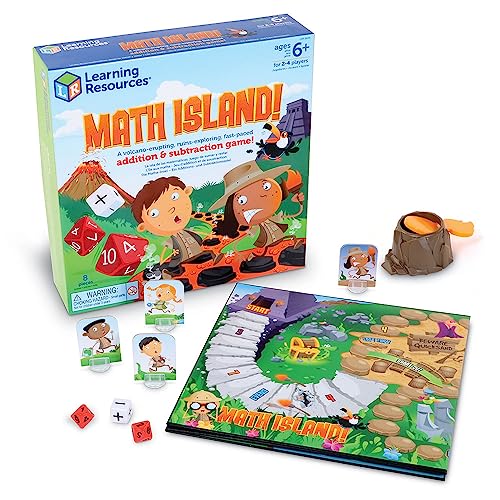
This game turns math practice into a volcano island adventure, where players solve addition and subtraction problems to navigate the map. It builds math confidence through repeated exposure to essential facts, using two 10-sided dice and an operation die to create varied equations. The engaging gameplay mechanics add a thrilling element with a volcano popper, encouraging kids to play again while reinforcing computational fluency and quick mental math skills.
Learning Resources MathLink Cubes Big Builders

Big Builders extends the classic MathLink Cube concept with 200 cubes in ten colors, designed to connect on all sides for diverse pattern-building and STEM projects. Children practice counting, sorting, and basic operations, while the open-ended activity guide encourages creativity. The sets promote spatial reasoning, problem-solving, and engineering thinking as learners construct animals, vehicles, and structures, making it suitable for centers and independent work as well as guided lessons.
SpriteGru Math Linking Cubes

This value-packed set includes 100 cubes in vibrant colors, a reusable double-sided card, markers, and star stickers. The linked cubes support place value concepts, counting, and comparison. Early STEM activity is emphasized, with kids practicing counting, sorting, and basic arithmetic while developing critical thinking and color recognition. The product is well-suited for homeschool, math centers, or classroom use, encouraging hands-on exploration and collaborative learning.
TOMMYHOME Base Ten Blocks With Place Value Chart

This set focuses on base-ten understanding with a complete counter collection, storage, and a reusable writing mat. It includes unit blocks, tens flats, hundreds rods, and a place value chart, making it a strong option for 1st through 4th grade. The kit supports teaching tools in classrooms or homeschooling, helping students visualize addition, regrouping, and place value concepts with hands-on manipulatives while simplifying tidying up after lessons.
Buying Guide: Key Purchase Considerations
- Age and skill level: Choose manipulatives that match a child’s current math stage, from counting and patterning to place value and operations.
- Curriculum alignment: Look for sets that reinforce standard topics such as counting to 100, basic addition/subtraction, place value, and measurement.
- Engagement and durability: Bright colors, durable materials, and versatile designs encourage longer use and broader activities.
- Versatility: Sets that allow multiple configurations (tubes, blocks, cards) support varied lesson plans, centers, and independent work.
- Storage and organization: Consider how easily pieces are stored and whether the set includes containers or a helpful storage box.
- Teacher and caregiver support: Some products offer activity guides or included lesson ideas, saving planning time.
- Group learning suitability: If using in classrooms, ensure the set supports small-group activities and centers, not just individual practice.
- Maintenance: Reusable dry-erase components or easy-to-clean surfaces can extend the life of the manipulatives in busy learning spaces.
- Cost versus value: Compare the number of pieces, color variety, and included resources to ensure lasting educational value.
- Expandability: Some sets work well when combined with other manipulatives for progressive challenges as skills advance.
Incorporating manipulatives into math instruction supports concrete understanding of abstract concepts. The five selections above cover counting, base-ten concepts, operations, and pattern-building through hands-on play. For best results, pair each manipulative with short, targeted activities that align with learning goals and provide frequent opportunities for guided exploration and independent practice.