Finding developmentally appropriate toys for an 11-month-old can support early cognitive skills, motor development, and sensory exploration. This guide highlights five Montessori-inspired options that emphasize tactile learning, stacking, sorting, and object permanence—without screens. Each toy aligns with typical 11-month milestones such as improved hand-eye coordination, curiosity for cause-and-effect, and safe handling of small parts under supervision.
| Product | Brand |
|---|---|
| JUXUE Baby Spinning Stacking Toys for Toddlers 1-3 | JUXUE |
| Adena Montessori Object Permanence Box with Tray | Adena Montessori |
| WOODMAM Montessori Toys for Babies 6-12 Months | WOODMAM |
| KMTJT Toddlers Montessori Wooden Toys | KMTJT |
| MINGKIDS Montessori Toys, 6 Pc Multi-Sensory | MINGKIDS |
JUXUE Spinning Rainbow Stacking Toy
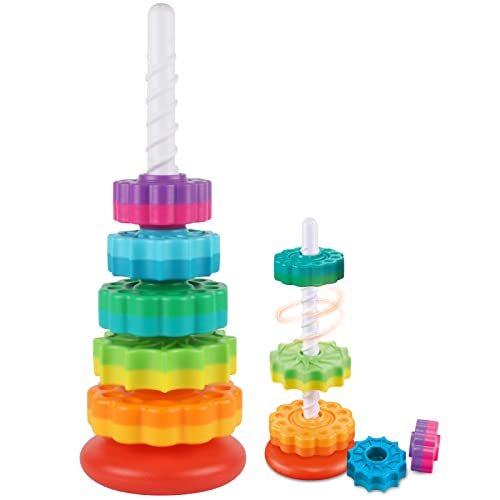
The JUXUE spinning stacking toy combines a screw rod with colorfully colored discs that rotate freely. Discs come in two-tone colors and can be stacked by size, color, or shape. When the stacking is complete, the base can be flipped to shake or fix, and the pole can be pulled to release the discs for a playful fall. The design supports cause-and-effect learning and color recognition while encouraging grasping and fine motor control.
Adena Montessori Object Permanence Box with Tray

This object permanence box introduces infants to the concept that objects persist even when out of sight. The tray includes three balls of different textures—blue wooden, green plastic, and pink EVA soft—providing varied tactile feedback to stimulate sensory exploration. The included balls also help practice grasping and dropping into designated holes, supporting fine motor development and hand-eye coordination.
WOODMAM 9-in-1 Montessori Wooden Toys Set

This 9-in-1 wooden set offers multiple Montessori activities, including a traditional egg cup, mirror puzzle, stacking cups, and more. Designed for sensory development and imaginative play, it emphasizes safe, natural wood construction with rounded edges and non-toxic finishes. The variety supports tactile exploration, sorting, and early problem-solving without screens.
KMTJT Shape Sorting Wooden Toys for 1-3 Year Olds

This wooden set includes 12 fruit blocks, 8 carrots, 10 worms, and a five-sided cart, offering varied shapes and textures. It supports color and shape recognition, hand-eye coordination, and fine motor skills through sorting, matching, and imaginative play. The chunky design makes it suitable for small hands and early exploration.
MINGKIDS Six-Piece Sensory Shapes

The MINGKIDS set features six chunky, textured shapes designed to awaken tactile senses and promote color and shape recognition. Babies explore with fingers and hands, enhancing fine motor skills as they push, pull, and manipulate the blocks along elastic bands. These multi-sensory pieces align with early cognitive development goals in a Montessori context.
Buying Guide
- Age appropriateness: Choose toys labeled for 6–12 months or 1–2 years, focusing on gross and fine motor skills, object permanence, and sensory exploration.
- Safety and materials: Opt for natural wood or non-toxic finishes, rounded edges, and large pieces to reduce choking hazards. Check for ASTM/CPSIA compliance on wooden toys.
- Skill development focuses:
- Object permanence and problem solving: boxes, cups, and shape sorters
- Fine motor and hand-eye coordination: stacking discs, blocks, and pull-to-release toys
- Sensory exploration: textured shapes and varied materials (wood, plastic, fabric)
- Durability and maintenance: Look for sturdy construction and easy-clean finishes. Wood toys may require occasional oiling; plastic toys should be BPA-free.
- Multisensory value: A mix of visual, tactile, and auditory elements (sound-producing discs or rattling components) can sustain interest and learning.
- Storage and space: Consider compact sets for small play areas and modular options that can expand as the child grows.
- Budget and value: Higher-quality wooden Montessori sets often offer longer play value and safety, though more affordable plastic options can still support core skills.