Parents and educators seek engaging toys that spark curiosity about science while supporting early learning. The following space-themed planet toys are ideal for toddlers and preschoolers, blending hands-on exploration with foundational astronomy concepts. Each option emphasizes safe materials, bright visuals, and easy-to-use designs that encourage fine motor skills, problem solving, and imaginative play. Explore a mix of wooden puzzles, felt boards, projectors, and interactive sets to find the best fit for your little space explorer.
| Product | Key Benefit |
|---|---|
Note: The selections prioritize educational value, durability, and age-appropriateness for toddlers and preschoolers. Each product page provides a snapshot of materials, scope, and how it supports early science understanding through play-based learning.
BONNYCO Solar System With Felt Board

The BONNYCO solar system set centers on a felt story board featuring 13 planets, the Sun, and the Moon, plus labels for 15 celestial names. It includes dwarf planets (Ceres, Pluto, Haumea, Makemake, Eris) and two adhesives to mount the panel on a wall. This kit supports early literacy and science by letting kids arrange planets, stars, and astronauts while learning naming conventions. The hands-on arrangement reinforces order, spatial relations, and memory recall, with a Montessori-inspired approach that blends learning and storytelling.
Zeoddler Solar System Puzzle For Kids 3-6

This wooden solar system puzzle offers vibrant planet shapes and a child-friendly layout designed for 3+ year olds. The puzzle introduces planets, including the Sun and Moon, with careful attention to color and form to aid recognition. As children fit pieces, they practice hand-eye coordination, problem solving, and cognitive mapping of the solar system. Its durable wood construction supports repeated use in classrooms or at home, while encouraging independent exploration and early STEM skills.
BLAZPATH Solar System Wooden Puzzle Toy

The BLAZPATH wooden puzzle features 10 real-planet puzzles on a portable board, crafted for easy handling by toddlers. Its lightweight design (about 180g) makes it ideal for travel, car rides, or classroom activities. The circular, toddler-friendly pieces promote fine motor development, color recognition, and spatial awareness as kids assemble the solar system. This Montessori-inspired set emphasizes physical interaction with space concepts, offering a practical, compact option for space-themed learning on the go.
Learning Resources Shining Stars Projector
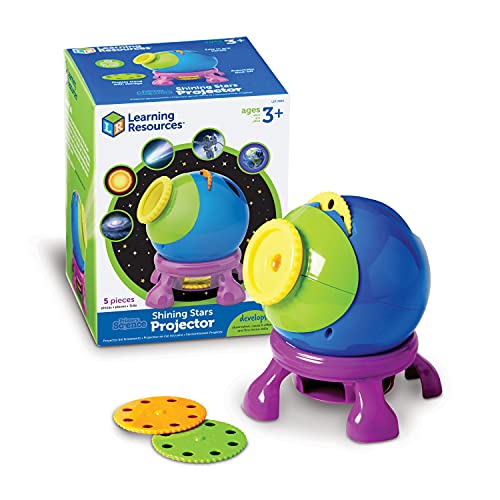
This projector adds a space exploration dimension by projecting stars, planets, and space scenes onto walls or ceilings. It supports early language development and cause-and-effect understanding as children observe how different celestial images illuminate their environment. The project can be used for storytelling or quiet time, providing a visual complement to other hands-on space toys. Its glow-in-the-dark style helps children connect nighttime skies with daytime learning while fostering curiosity about astronomy.
iPlay, iLearn Kids Space Toys Set

The iPlay, iLearn space toy set features a spaceship play theme with an interstellar station, an astronaut figure, and a robot-inspired screwdriver that doubles as a pretend tool for assembly. The kit encourages imaginative play while supporting STEM skills, spatial reasoning, and fine motor development. With multiple space-station elements, children can craft diverse space scenes, build narratives, and explore concepts like docking, orbit, and exploration in a safe, age-appropriate format.
Buying Guide: Key Purchase Considerations
When selecting planet toys for toddlers, consider material safety, durability, and age suitability. Wooden puzzles often offer longevity and tactile richness, while felt boards provide flexible, reconfigurable play that supports storytelling and sequence learning. Look for clearly labeled planets to reinforce memory and vocabulary. If choosing a projector, ensure brightness levels are comfortable for young eyes and use in dim lighting for best effect. Size and portability matter for busy families—compact options are great for travel, while larger felt mats can transform a play area into a mini space lab. Finally, assess whether the set supports STEM exploration through hands-on assembly, problem solving, and open-ended play versus single-story activities. Comparing the depth of content, such as including dwarf planets or space objects beyond the basics, helps tailor the toy to your child’s curiosity and your educational goals.