Programable toys empower kids to explore coding, engineering, and creative problem solving through hands-on play. The following five selections offer a mix of remote, app-controlled, gesture-sensing, and building-block robotics designed to engage children ages 3–14. Each option emphasizes STEM learning, durability, and engaging features like voice control, motion sensing, and modular building. Use this guide to contrast capabilities, setup, and long-term value for budding engineers and designers.
| Product | Brand | Highlights | Ideal For |
|---|---|---|---|
| Ruko 1088 Smart Robots for Kids | Ruko | Voice control, APP control, 10 expressions, 9 joints, 10 songs | Imaginative play and early programming |
| KingsDragon RC Robot Toys | KingsDragon | Gesture control, remote control, 50 action demonstrations | Hands-on programming with motion actions |
| HOLIBIBE Remote Control Robot Dog | HOLIBIBE | 20+ functions, pet-sensing, auto demo, music and dancing | Pet-simulated play and responsive routines |
| Henoda Robot Building Toys Stem Projects | Henoda | 443+ pcs, remote and app control, light-up eyes, 360° rotation | Hands-on building with programming and app control |
| ELEGOO UNO R3 Smart Robot Car Kit V4 | ELEGOO | Arduino-based, 24 modules, line tracing, obstacle avoidance | STEM coding and electronics basics |
These products illustrate diverse pathways to learning: from app-driven programming and voice control to gesture sensing and modular construction. Whether you’re shopping for a younger beginner or an older child exploring robotics, each choice offers different avenues for curiosity and skill growth.
Below you’ll find detailed product sections with image previews, core features, and learning-oriented considerations to help compare how each device supports creativity, problem solving, and practical technics like sequencing, debugging, and project planning.
Ruko 1088 Smart Robots For Kids

The Ruko 1088 stands out with a tall, interactive figure that students can program through both voice and a mobile app. It offers 10 expressive moods and 9 joints for dynamic movement, making playtime feel lifelike. Ten songs add a musical layer to demonstrations and storytelling. With a height of up to 15.8 inches, it functions as a showpiece for classroom or family activity, while reinforcing sequencing, cause-and-effect reasoning, and early programming concepts.
Key aspects include multi-modal control (voice and app), diverse activities such as gymnastics and recording, and opportunities to build narrative and choreography into routines. This model emphasizes imaginative play alongside STEM fundamentals and can be used to illustrate basic logic, timing, and motor planning in a tangible way.
KingsDragon RC Robot Toys

This gesture-sensing robot blurs the line between remote control and autonomous action. In addition to infrared command control, it can turn based on hand gestures, offering intuitive interaction that complements progressive programming steps. The 50-user-programmed actions allow children to design and replay motions like patrols, dances, and sequences. The robot’s eyes light up during movement, enhancing visual feedback during practice sessions and storytelling moments.
Educational value centers on programming logic, action sequencing, and motor coordination. The hardware is designed to be non-toxic and sturdy, suitable for repeated experimentation with different action sets. It’s a solid option for kids who prefer tactile control with occasional autonomous demonstrations to observe how simple inputs translate into complex outcomes.
HOLIBIBE Remote Control Robot Dog

The HOLIBIBE robot dog combines expressive movement with a broad feature set, including programmable routines, demonstrations, and music playback. Petting can trigger automatic demonstrations, and the device supports more than 20 functions—like barking, dancing, greetings, and postures. The design emphasizes safe handling, with rounded edges and durable ABS materials, making it a practical option for kids who want a responsive companion during playtime.
From a learning perspective, children explore sequencing, cause-and-effect, and memory patterns as they program routines or observe the dog’s automatic modes. The device also introduces basic battery management and recharge cycles, which are foundational for responsible tech usage. This toy suits children who enjoy personalities and interactive storytelling with a tangible pet-like partner.
Henoda Robot Building Toys Stem Projects
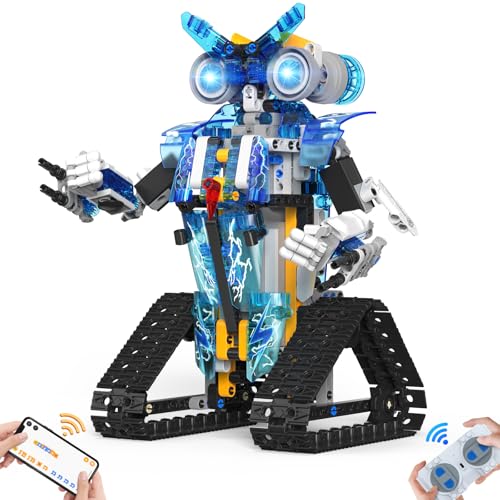
Henoda combines a large set of building blocks with remote and app control, enabling detailed STEM construction projects. The 443+ pieces enable kids to assemble complex robots with transparent sections and decorative stickers, encouraging patience, concentration, and logical thinking. Features like glowing eyes and movable limbs add a sense of realism to the models and can help illustrate joint mechanics, torque, and range of motion.
Programming options include 2.4GHz remote control as well as a mobile app that supports multiple modes: remote, voice control, gravity sensor, stem programming, and path mode. A typical run time of about 40 minutes per charge allows for multiple long-form projects. This set is ideal for learners who enjoy step-by-step construction, experimentation, and long-term project planning.
ELEGOO UNO R3 Smart Robot Car Kit V4

The ELEGOO kit is a classic entry point for Arduino-based robotics. It includes 24 module parts such as obstacle avoidance and line tracing, with compatibility for Android and iOS smartphone control. The assembly process is designed to be approachable for beginners, featuring clearly labeled interfaces to reduce setup errors. It’s an excellent choice for kids who want to learn electronics fundamentals, basic programming flows, and hardware integration through hands-on experimentation.
Educational benefits include understanding sensors, motor control, timing diagrams, and debugging strategies. The kit can scale with more advanced projects, offering a pathway from simple motor control to more complex autonomous behaviors. The hands-on nature fosters persistence, logical thinking, and an appreciation for how software and hardware interact.
Buying Guide
Consider these factors when selecting a programmable toy for kids:
- Age and safety: Choose age-appropriate models with non-toxic materials and sturdy construction for active play.
- Control method: Decide whether you prefer remote, app-based, gesture-sensing, or voice-driven interfaces. Some products offer multiple control modes for versatility.
- Learning goals: For younger children, focus on basic sequencing and cause-and-effect. Older kids can benefit from programmatic thinking, debugging, and hardware integration.
- Expansion potential: Look for sets with modular parts, open-ended building options, and compatibility with other kits to extend learning.
- Battery life and charging: Longer play sessions are helpful; consider recharge time and battery accessibility for kids learning to manage power usage.
- Durability and safety features: Smooth edges, sturdy casings, and compliant materials reduce risk during enthusiastic play.
- Software access: Apps that support learning modes, guided tutorials, and simple programming languages can influence the overall experience and retention.
When comparing options, assess the balance between immediate “play” value and long-term educational benefits. A product that supports step-by-step progression—moving from simple actions to more complex programs—often provides the strongest return on investment for developing coding and problem-solving skills.