Stage blocks and construction-type sets are increasingly used in early childhood programs and special education to support language, social interaction, and STEM thinking. This article highlights five carefully chosen stage block kits that align with classroom needs—from language development to geometric concepts and critical thinking. Each product includes features that can facilitate structured play, guided assessment, and creative exploration for students in K–8 and preschool settings.
| Product | Brand |
|---|---|
| Stages Learning Materials Language Builder Block Imitation Kit Curriculum for Autism & Preschool | Lang-O-Learn |
| Learning Resources View-Thru Geometric Solids | Learning Resources |
| Learning Resources Mental Blox Critical Thinking Game | Learning Resources |
| Excellerations Mini Ice Building Blocks | Excellerations |
| DJECO TopaniHouse Wooden Blocks | DJECO |
Stages Learning Materials Language Builder Block Imitation Kit

The Lang-O-Learn Language Builder Block Imitation Kit combines 40 vibrant wooden blocks with 100 picture cards to support pretend play and language development. This set is designed for autism and preschool classrooms, offering a structured way for students to imitate actions, expand vocabulary, and practice turn-taking during guided sessions. The kit’s blocks are color-coded to invite different build sequences, while the accompanying iPad app provides an optional digital extension for articulation practice and storytelling. The combination of physical blocks and digital resources supports multiple learning styles and can be integrated into language sessions, social skills groups, or early literacy centers.
Key features and classroom implications include: durable wooden blocks in bright colors, 40 blocks ready for play and structured activities; 100 unique picture cards that illustrate simple structures from 1 to 40 blocks, enabling scalable challenges; an accessible app option to enhance language practice and recording of progress. This kit is suitable for small-group therapy settings or home-schooling environments as part of a broader language curriculum. Teachers can use the cards to prompt descriptive language, model sentence structure, and reinforce sequencing skills during block construction sessions.
Learning Resources View-Thru Geometric Solids
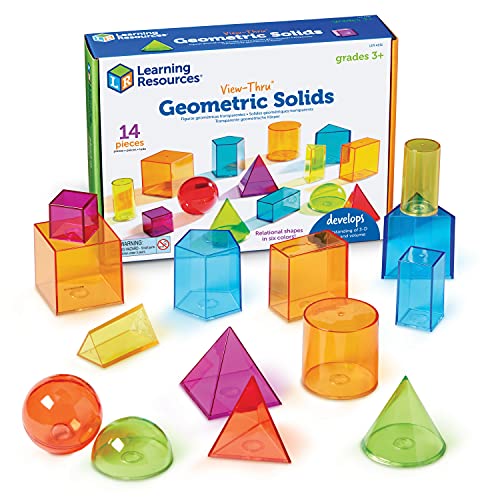
These transparent geometric solids provide a tactile way to explore 3D shapes, volume, and measurement concepts. The clear, colored shapes let students visualize interior structure, making abstract geometry tangible. Classroom teachers can use the set to demonstrate how shapes fit together, compare volumes, and discuss spatial relationships. Removable bases and fill holes support hands-on experiments with liquids or materials, ideal for explorations in early math and science stations. While targeted to K–8, the materials appeal to younger learners through color recognition and early shape identification, and they can be threaded into literature or science-themed centers for interdisciplinary lessons.
With these solids, students can build, deconstruct, and reassemble shapes to observe how volume changes with different configurations. Teachers may assign tasks such as comparing the volume of a cube versus a rectangular prism or predicting how adding a base affects stability. The visual access provided by the transparent design helps learners articulate reasoning and describe features, supporting both language development and mathematical understanding in a classroom setting.
Learning Resources Mental Blox Critical Thinking Game
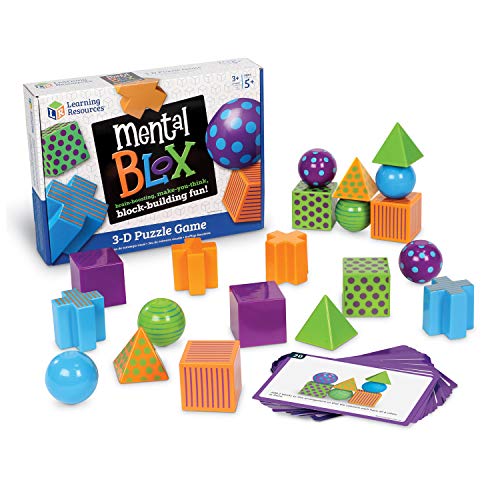
Mental Blox is a versatile critical thinking game built around stackable, multicolor blocks and activity cards. The set emphasizes following verbal instructions, asking questions, and building reasoning skills as students replicate designs or devise their own patterns. The activity cards provide concrete examples and challenge levels, making it suitable for small-group instruction or independent practice. As a homeschool or classroom resource, Mental Blox supports foundational math concepts like pattern recognition, symmetry, and spatial awareness, while also fostering communication and collaborative problem-solving during building sessions.
The kit is easy to adapt for various age ranges and ability levels. Teachers can sequence activities from simple to complex, gradually increasing cognitive demand. The physical manipulation of blocks coupled with open-ended prompts can be used to assess comprehension, language use, and particularly the ability to translate instructions into a constructed model. This feature makes Mental Blox a practical addition to stations focused on STEM thinking, literacy support, and social-emotional learning through collaborative play.
Excellerations Mini Ice Building Blocks

Excellerations mini ice building blocks offer compact construction options with an ice-inspired aesthetic. The set includes 36 blocks and five laminated activity cards, designed to inspire STEM thinking in a compact workspace. The blocks’ translucent blue color creates an engaging light-table or daylight contrast, making structures glow and attract student attention during demonstrations or independent building time. Activity cards present 10 build ideas across two-sided designs, including ice walls and arctic-inspired columns, which encourage students to experiment with balance, volume, and symmetry in a fun, themed context.
In practice, educators can use these blocks to scaffold math and science exploration: planning, modeling, and testing structural stability. The small size makes them suitable for tabletops and small centers, while the light-transmitting material adds a sensory dimension for learners who respond to visually rich stimuli. Teachers can incorporate peer collaboration by assigning roles, such as designer, builder, and reviewer, to support communication and cooperative problem solving in a group setting.
DJECO TopaniHouse Wooden Blocks

The DJECO TopaniHouse set offers whimsical farm-themed blocks and illustrated animal pieces that invite open-ended storytelling and imaginative play. This wooden block collection supports early literacy and narrative skills as children construct farmhouse scenes, fences, and farmyard scenarios. The open-ended nature helps learners explore spatial reasoning, balance, and fine motor control while engaging in social interactions during collaborative play. The farm-safe wooden pieces are designed for durability in school settings, and the variety of shapes encourages planning and sequencing as students decide how to place blocks to create stable farm structures.
Buying Guide
- Learning goals: Choose sets that align with your curriculum—language and social-emotional development, geometry and measurement, critical thinking, or STEM exploration. Some kits blend multiple goals through guided activities, while others are best for free play with minimal teacher input.
- Age and ability range: Consider the age range and accessibility of each kit. For mixed-classrooms, look for blocks with scalable challenges (e.g., cards with progressive difficulty) to accommodate learners from preschool through elementary grades.
- Durability and materials: Wooden blocks are sturdy for daily classroom use, while transparent plastic and laminated cards can enhance visibility and durability in busy centers. Ensure the blocks are smooth, splinter-free, and meet safety standards for school environments.
- Assessment and documentation: Some sets include digital apps or activity cards that help teachers track progress, vocabulary development, or problem-solving strategies. If assessment support is important, prioritize kits with built-in progress tracking or easy-to-record metrics.
- Classroom integration: Consider how each kit fits with existing centers (language, math, science, and fine motor stations). Look for sets that can be easily rotated through different centers to maximize instructional time and student engagement.
- Versatility and storage: Check for a reasonable number of pieces per kit and whether accessories (e.g., activity cards, bases) are included. Durable bins or organizers help maintain classroom order between rotations.
- Budget and scalability: For schools, it can be beneficial to select a core set with optional add-ons. Assess whether the purchase supports continued use across multiple grade levels and classrooms without a rapid need for replacement.
- Teacher support: Some brands provide lesson ideas, printable activities, or app-based prompts to guide instruction. Evaluate the availability of teacher resources to maximize effective use.
- Inclusivity and accessibility: Choose options that support diverse learners (language development, cognitive flexibility, and motor skills). Multi-sensory components and visual supports can benefit students with different learning needs.
These considerations help educators select stage block kits that deliver consistent, measurable classroom benefits. By combining tangible blocks with guided activities, teachers can foster cooperative play, language development, mathematical thinking, and creative problem solving in a structured yet exploratory learning environment.