Explore top STEM kits that engage teens with hands-on projects, critical thinking, and practical engineering concepts. The following selections offer a mix of mechanical, electronic, and solar-powered experiments designed to enhance problem-solving skills, while staying age-appropriate for teens. Each kit emphasizes real-world application, safe construction, and clear, step-by-step instructions to maximize learning and fun.
| Product | Brand |
|---|---|
| The Thames & Kosmos Mega Cyborg Hand Stem Experiment Kit | Thames & Kosmos |
| ELEGOO UNO R3 Smart Robot Car Kit V4 | ELEGOO |
| ELEGOO Conqueror Robot Tank Kit with UNO R3 | ELEGOO |
| Lucky Doug Solar Power Kits | Lucky Doug |
| Bottleboom 13-in-1 Solar Robots | Bottleboom |
The table above highlights five standout STEM kits that are well-suited for teenagers seeking immersive, project-based learning. Each kit offers unique angles—from pneumatics and robotics to solar power—ensuring a broad exposure to core STEM topics while promoting creativity and independent exploration.
Thames & Kosmos Mega Cyborg Hand STEM Kit

This wearable hydraulic hand demonstrates pneumatic principles without motors or batteries. Teen builders assemble hydraulic pistons that open and close fingers, enabling object gripping with measurable force. Each finger joint is adjustable, supporting precise movement and customizable fit. The kit emphasizes practical applications of air pressure and hydraulics, offering a tangible way to study mechanical advantage and control systems. It blends engineering with a wearable component for an engaging, visible outcome that reinforces concepts learned in classroom settings.
ELEGOO UNO R3 Smart Robot Car Kit V4

Designed for beginners and intermediates, this Arduino-based car kit introduces programming, electronics assembly, and robotics fundamentals. It includes 24 module parts such as obstacle avoidance and line tracing, with control possible via Android and iOS devices. Clear module interfaces (XH2.54) simplify assembly, reducing errors and supporting quick progression from basic wiring to more advanced programming. This kit emphasizes hands-on software-hardware integration, fostering iterative debugging and computational thinking.
ELEGOO Conqueror Robot Tank Kit with UNO R3
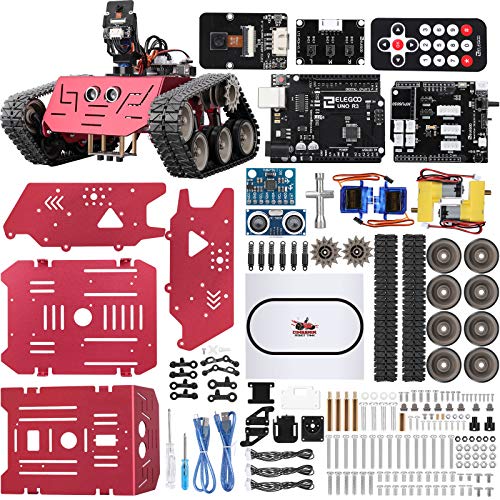
Built on Arduino, this tank-style robot offers DIY assembly to boost concentration and hands-on skills. The kit features graphical programming blocks and a versatile car platform that sparks creativity and STEM curiosity. Teens can explore motion control, sensor integration, and autonomous behavior while developing practical problem-solving abilities. The open-resource nature provides a solid foundation for extended projects and customization.
Lucky Doug Solar Power Kits
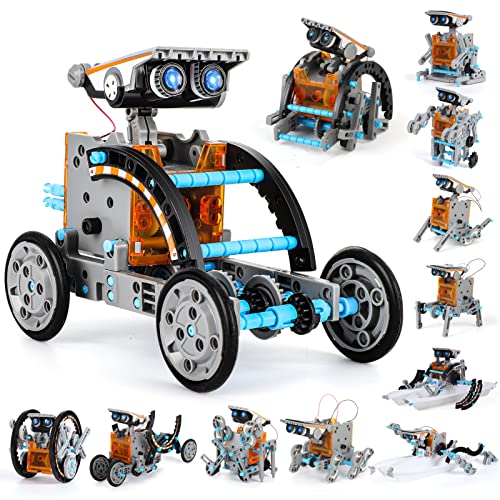
These 12-in-1 solar robot kits offer a wide range of build options powered entirely by sunlight. The project set teaches renewable energy concepts, mechanical design, and proportional reasoning through practical construction. The parts are designed for easy disassembly, encouraging repeated experiments and iterative learning. Clear instructions guide teens through solar-powered movement, enabling exploration of energy efficiency, trajectory planning, and basic robotics control in outdoor or well-lit environments.
Bottleboom STEM 13-in-1 Solar Robots

The Bottleboom solar robot kit enables building 13 different robots from one base set, moving on land or water using solar energy. It promotes systematic experimentation with gears, plates, tires, and shafts. The solar-powered design encourages understanding of renewable energy sources and practical energy conversion. The included manual provides step-by-step builds, while the modular approach supports experimentation with reconfiguration and testing various robot designs.
Buying Guide
- Learning objectives: Choose kits aligned with the teen’s goals—robotics, electronics, pneumatics, or renewable energy—to maintain engagement and clear progression.
- Complexity and upscaling: Look for kits with adjustable difficulty or multiple project options to grow with the learner and avoid early boredom.
- Programming vs. no-coding: Some kits emphasize hands-on hardware with optional programming, while others require coding knowledge. Select based on current skills and future needs.
- Open-source resources: Arduino-compatible kits and those with abundant tutorials help teens tackle troubleshooting and extend projects beyond the box.
- Safety and materials: Prioritize non-toxic materials, rounded edges, and clearly labeled components for safe handling during independent or guided play.
- Expandability: Kits that allow adding sensors, motors, or extra modules enable longer-term learning and more sophisticated projects.
- Outdoor suitability: Solar kits work best with strong ambient light; consider indoor-friendly options for year-round use if needed.