Discover adult-friendly coding kits that blend electronics, programming, and real-world projects. This guide highlights five top kits that blend beginner-friendly tutorials with more advanced features, helping adults build practical skills in Arduino, Python, Scratch, and IoT. Each option is evaluated for accessibility, expandability, and learning value, making it easier to choose a kit that fits your goals and schedule.
| Product | Brand | What It Teaches | Key Benefit |
|---|---|---|---|
| ELEGOO Mega R3 Project Starter Kit | ELEGOO | Arduino programming, electronics fundamentals, LCD modules | Extensive parts with guided tutorials |
| ELEGOO UNO Project Super Starter Kit | ELEGOO | Arduino basics, LCD module integration, software setup | Economical, beginner-friendly |
| KEYESTUDIO IoT ESP32 Smart Home Starter Kit | KEYESTUDIO | IoT, microcontrollers, MicroPython and C | Smart home focus with multi-language support |
| Adventure Kit: 30 Days Lost in Space | inventr.io | Video-guided electronics, mission-based coding | Engaging storytelling approach |
| Makeblock Cyberpi Project-Based Kit | Makeblock | Scratch to Python, AI, IoT with built-in WiFi | All-in-one STEM platform |
ELEGOO Mega R3 Project The Most Complete Ultimate Starter Kit

The ELEGOO Mega R3 Starter Kit provides a comprehensive Arduino ecosystem, combining a MEGA2560 board with more than 200 components. The package highlights include a PDF tutorial with over 35 lessons, an LCD1602 module, and a GY-521 sensor module. A key advantage is solder-free setup for essential modules, which accelerates hands-on learning for adults starting with embedded systems and progressing toward larger projects. The kit supports a broad range of experiments from simple LED patterns to sensor-driven applications.
ELEGOO UNO R3 Smart Robot Car Kit V4 for Arduino Robotics

The ELEGOO UNO R3 Smart Robot Car Kit is designed for beginners and those new to robotics. It integrates 24 distinct modules, including obstacle avoidance and line-tracing components, enabling hands-on learning of circuits, sensors, and simple control algorithms. The package emphasizes ease of assembly thanks to standardized interfaces (XH2.54 ports), reducing setup errors. It’s suitable for adults seeking a structured robotics introduction while offering opportunities to extend with smartphone control and additional modules.
ELEGOO UNO Project Super Starter Kit

This UNO Project Starter Kit focuses on the Arduino platform with a practical kit environment. It includes a tutorial set with more than 22 lessons and a clear component layout, making electronics approachable for beginners. The included LCD1602 module with a pin header eliminates soldering steps, streamlining early projects while exposing users to real-world display interfaces and basic data communication. The kit is a cost-effective entry point for adults building confidence in microcontroller projects.
KEYESTUDIO IoT ESP32 Smart Home Starter Kit

The KEYESTUDIO IoT ESP32 kit targets adults curious about smart home tech and IoT. It blends entry-level coding with practical devices like sensors and actuators. The kit supports two programming languages—C and MicroPython—and provides 13 tutorials, including mobile control concepts. It enables you to explore home automation basics—from lighting control to environmental sensing—without being overwhelmed by complex software setups. The emphasis on 13 projects makes it well-suited for steady, project-driven learning.
Adventure Kit: 30 Days Lost in Space
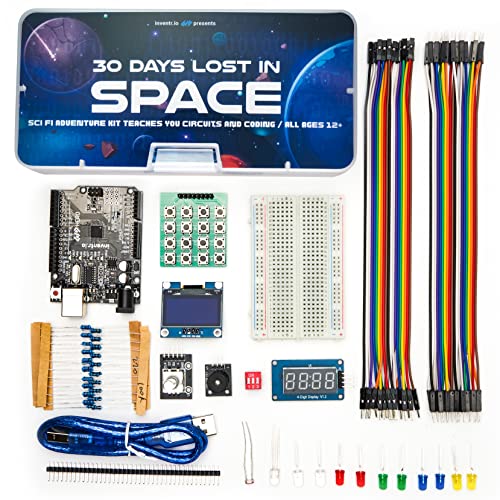
The Adventure Kit brings an immersive, cinematic approach to learning electronics. A 30-day video storyline guides challenges that feel like an adventure rather than a traditional course. Taught by professional educators and a NASA researcher, the program emphasizes hands-on problem solving, practical experimentation, and community support through a large maker network. This format suits adults who prefer structured, narrative-driven instruction over static PDFs.
Makeblock Cyberpi Project-Based Kit

The Makeblock Cyberpi kit centers on a versatile microcomputer with built-in WiFi and Bluetooth, supporting Scratch and Python. It emphasizes project-based learning, guiding users from visual programming to text-based coding and AI concepts. A standout feature is its breadth: sensors, a color display, motion sensors, and an expansion pathway for future projects. The kit’s all-in-one design makes it a robust platform for adults seeking a cohesive STEM experience that scales with skill progression.
Buying Guide: Key Purchase Considerations
When choosing a coding kit for adults, consider the intended learning path and project scope. Beginners benefit from kits with clear tutorials, solder-free assemblies, and well-labeled components. If you expect to progress toward IoT or AI, look for kits with microcontrollers that support Python or MicroPython, WiFi connectivity, and compatible software ecosystems. Expandability matters: modules, shields, and add-ons determine long-term value as skills grow. Finally, assess whether the teaching style—video-guided paths, project-based challenges, or traditional manuals—matches your preferred learning approach and available time.
For practical, hands-on outcomes, assess how each kit handles real-world tasks. Arduino-centric kits teach fundamentals like digital and analog I/O, sensors, and serial communication. IoT kits emphasize networked devices, cloud or phone integration, and remote control capabilities. Robotics-focused kits provide mechanical design experiences alongside coding. A well-balanced selection pairs a strong foundational kit with one that introduces ongoing experimentation and a pathway to more advanced topics as confidence builds.
Security and safety considerations are worth noting for adult learners. Choose kits with clear warnings about power requirements and safe handling of modules. Favor components with robust plastic housings or protective casings for delicate sensors. If you’re sharing with family or coworkers, consider kits that keep workspaces tidy with organized storage cases and labeled connectors to minimize setup confusion.
Availability and price range can influence your decision. The five kits above offer a spectrum from economical starter options to feature-rich systems. Depending on how deeply you intend to dive into electronics, you may prioritize tutorials, hardware quality, or the ability to scale with advanced projects. Always verify the latest reviews and update notes from manufacturers to ensure compatibility with current software and operating systems.