Counting cubes offer a hands-on way for children to explore number sense, patterning, counting to 100, and early arithmetic. This guide highlights five top counting cube sets that align with preschool, kindergarten, and early elementary learning. Each option emphasizes color, counting, and hands-on manipulation to support school readiness in homes and classrooms.
| Product | Brand | Main Benefit |
|---|---|---|
| MathLink Cubes — Set of 100 | Learning Resources | Foundational counting, one-to-one correspondence, and basic operations |
| MathLink Cubes Big Builders — Set of 200 | Learning Resources | Expanded quantity for larger projects and early engineering play |
| SpriteGru Math Linking Cubes — 100 | SpriteGru | Colorful, versatile manipulatives for counting and construction |
| KUTOI Math Manipulatives Counting Cubes — 100 | KUTOI | Vibrant blocks to visualize addition, subtraction, patterns |
| STEM Explorers MathLink Builders — 100 | Learning Resources | STEM-focused building and early engineering with linking cubes |
Selected Products
Learning Resources MathLink Cubes — 100 Cubes
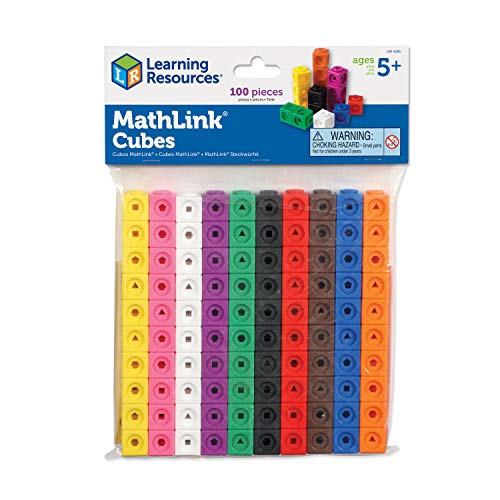
These MathLink Cubes are a staple for early math exploration. The 100-piece set supports one-to-one counting, identifying numbers up to 100, simple addition and subtraction, and basic graphing activities. The cubes include color identification, shape awareness, and patterning opportunities, making them suitable for homeschool and classroom use. Each cube snaps together on all sides, enabling straightforward construction of patterns, sequences, and geometric shapes. The included activities support school readiness with a focus on foundational math skills and fine motor development.
Learning Resources MathLink Cubes Big Builders — 200 Cubes

The 200-cube Big Builders set expands counting play into larger projects and early engineering. Children can imagine and assemble models, from helicopters to robots, while practicing counting, addition, subtraction, and spatial reasoning. The large quantity gives ample opportunities for independent exploration or guided group activities. The cubes promote critical thinking through design challenges and an activity guide that supports teachers and homeschooling parents alike.
SpriteGru Math Linking Cubes — 100

SpriteGru’s 100-count set comes in 10 vibrant colors, making it easy to teach color recognition alongside counting, place value, and basic arithmetic. The linking design supports collaborative play, storytelling with math, and creative construction. Kids can build names, robots, or windmills while learning to compare quantities, practice addition and subtraction, and develop fine motor skills as they snap cubes together and apart. The varied colors also aid patterning and early STEM reasoning.
KUTOI Math Manipulatives Counting Cubes — 100

KUTOI offers 100 colorful cubes designed to support hands-on math learning. The vibrant pieces are easy for kids to stack and align, helping them visualize adding, subtracting, multiplying, and dividing concepts. The design emphasizes easy setup and quick cleanups, which keeps lessons flowing smoothly. With colors that help distinguish values and patterns, children can explore number sense, counting sequences, and basic operations in a tangible, engaging way.
Learning Resources STEM Explorers MathLink Builders — 100

STEM Explorers MathLink Builders blends math with beginner engineering. The 100-piece set fosters critical thinking as children build animals, objects, and imaginative structures while connecting cubes. This option emphasizes fine motor skills through manipulation and encourages STEM literacy with hands-on experimentation. It’s well-suited for small group lessons, independent centers, or family math play that extends beyond counting into construction and problem-solving.
Buying Guide: Key Considerations for Counting Cubes
- Age and skill alignment: Choose sets suited for preschoolers through early elementary, ensuring the complexity matches the child’s counting and basic operation abilities.
- Quantity and scalability: Start with 100 cubes for individual use; consider larger sets (200+) for group activities and more complex projects.
- Color and patterning options: Varied colors support quick counting, color identification, and patterning; consistent color coding can aid place value learning.
- Material quality and durability: Durable plastics with secure snapping mechanisms withstand frequent use and classroom wear.
- Educational value: Look for sets that include or pair with activity guides, cards, or lesson ideas that reinforce counting, addition/subtraction, and early STEM concepts.
- Storage and portability: Good storage options help keep materials organized and readily accessible for centers or homeschool routines.
- Safety and age suitability: Ensure pieces are sized appropriately for the target age group to minimize choking hazards for younger children.
- Teacher and caregiver usability: Sets that come with clear instructions or activity suggestions save planning time and enhance learning outcomes.
- Integration with other materials: Linking cubes pair well with number lines, base-ten blocks, and counting mats to broaden math exploration.