Choosing the right educational toys for 7-year-olds blends learning with hands-on fun. The selections below focus on STEM exploration, critical thinking, creativity, and problem-solving—key skills for this age. Each item supports curious minds with engaging activities that align with standard early-grade STEM concepts while offering durable, kid-friendly design. The buying guide at the end highlights practical considerations to help you compare options across features, age suitability, and learning outcomes.
| Product | Brand | Key Focus | Ideal For |
|---|---|---|---|
| STEM Kits for Kids Crafts 6-8 8-12 | BeAndge | Robotics, Solar & Wind Power, Hands-on Building | Budding inventors aged 8-12 (great for 7-year-olds starting STEM) |
| National Geographic Magic Chemistry Set | Blue Marble | Magic-inspired chemistry experiments | Young scientists who enjoy visual, magical demonstrations |
| ThinkFun Gravity Maze | ThinkFun | Logic, spatial reasoning, planning | Kids who like challenging puzzles and engineering |
| KLUTZ Lego Race Cars STEM Kit | Klutz | LEGO-based design, spatial reasoning, step-by-step building | Creative builders who like hands-on construction |
| Learning Resources STEM Explorers Brainometry | Learning Resources | Pattern blocks, brainteasers, math manipulation | Students strengthening geometry, logic, and fine motor skills |
BeAndge STEM Kits for Kids

The BeAndge STEM Kits offer a multi-piece set designed to engage children in robotics and basic engineering. The package includes a solar-powered car, a wind-powered car, an obstacle-avoidance robot, a transmission tank, and a glider. These projects provide hands-on experimentation with energy sources and movement, encouraging learners to predict outcomes and iterate on designs. Batteries are required but not included, making it suitable for classroom-style projects or family STEM activities. The kits are packaged in a gift-ready box, which makes them a thoughtful present for birthdays or holidays. This collection is especially useful for parents seeking group activity ideas and for teachers planning a classroom STEM project corridor.
Key features:
– 5 STEM kits including solar and wind-powered models
– Real-world gadgets that introduce energy conversion and robotics
– Encourages family involvement and classroom applications
– Gift-ready packaging suitable for birthdays and holidays
National Geographic Magic Chemistry Set
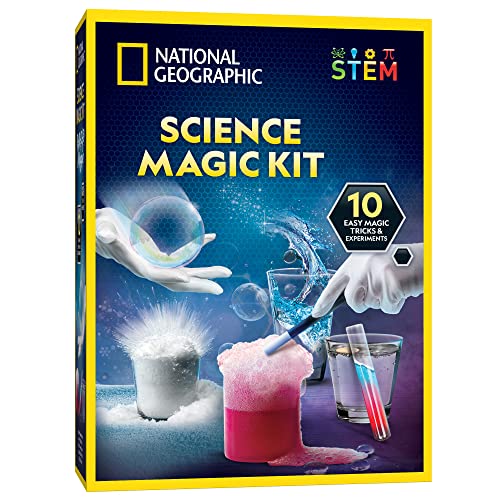
National Geographic’s Magic Chemistry Set blends science with spectacle. The kit features 10 experiments designed to look like magic tricks, often involving floating coins, color-changing liquids, and “magical” reactions. The included wand and gloves enhance theatrical presentation, turning scientific exploration into an engaging performance. The illustrated, kid-friendly guide offers clear steps and explanations, helping young experimenters grasp basic chemistry concepts while learning the responsible handling of materials. This kit is ideal for kids who enjoy wonder and storytelling as part of learning.
Key features:
– 10 magical chemistry demonstrations with kid-friendly instructions
– Included wand and gloves for theatrical experimentation
– Illustrated guide explaining underlying science in simple terms
ThinkFun Gravity Maze

Gravity Maze is a marble-based logic game that challenges spatial reasoning and planning. Children build a marble maze using 9 towers and 3 marbles to create a path from the start to the target, integrating problem-solving with engineering concepts. The game blends puzzle solving with strategic thinking, making it suitable for both individual play and classroom use. As children progress, they encounter more complex layouts, reinforcing sequencing and conditional thinking. This title supports steady cognitive development while remaining highly engaging.
Key features:
– Marble labyrinth with 9 towers and 3 marbles
– Combines puzzle solving with engineering planning
– Encourages strategic thinking and persistence
KLUTZ Lego Race Cars STEM Kit

Klutz’s Lego Race Cars kit combines book-style instructions with tangible building activities. The set guides kids through designing and constructing 10 distinctive LEGO race cars and a racetrack, emphasizing spatial reasoning, sequential thinking, and hands-on construction. It’s an excellent option for children who enjoy step-by-step projects and learning-by-doing. The format encourages independent work with clear guidance, yet leaves room for creativity when constructing variations or new designs.
Key features:
– 10 LEGO race cars with a supporting racetrack
– Step-by-step building guidance supports STEM skills
– Encourages spatial reasoning and creative problem-solving
Learning Resources STEM Explorers Brainometry

Learning Resources Brainometry emphasizes brainteasers, 3D puzzles, and pattern blocks to build logical thinking and mathematical fluency. The set includes a variety of hands-on activities designed to develop spatial awareness, pattern recognition, and fine motor skills. With double-sided activity cards, children can progress through increasing difficulty levels, promoting independent exploration while providing structured challenges. This kit is well-suited for learners who enjoy tactile manipulation and stepwise problem-solving.
Key features:
– 3D puzzles and pattern blocks for logic development
– 10 double-sided activity cards with increasing difficulty
– Supports math reasoning, spatial skills, and fine motor practice
Buying Guide: Key Purchase Considerations
- Age and skill alignment: Look for kits that explicitly support ages around 7-9 and emphasize beginner-to-intermediate levels to keep engagement high.
- Hands-on vs. guided activities: Some kits emphasize open-ended exploration, others provide structured, step-by-step instructions. A mix helps retain interest.
- Learning outcomes: Prioritize toys that foster critical thinking, problem-solving, spatial reasoning, and basic engineering concepts.
- Durability and safety: Check durable materials and age-appropriate small parts. Ensure components fit together securely and comply with safety standards.
- Multi-disciplinary benefits: Toys that blend science with math, art, or creativity provide broader cognitive development opportunities.
- Storage and portability: Consider how easy it is to store parts and transport items for travel or classroom use.
- Educational value vs. entertainment: Aim for a balance where play leads to measurable learning outcomes while remaining enjoyable.
The five chosen products cover a range of approaches—from hands-on robotics and chemistry to logic puzzles and pattern-based learning. They provide opportunities for individual exploration, family learning sessions, and classroom-style activities. When selecting, consider your child’s interests (mechanical construction, magic-themed science, or puzzle challenges) and your preferred environment (home, school, or club activities) to maximize engagement and educational impact.