Finding objects in the night sky becomes easier with a reliable finder scope. This guide highlights top finder scopes that help you locate targets quickly, align precisely, and enjoy clear, upright views. We compare common features like magnification, field of view, mounting compatibility, and illumination, so you can choose a finder that fits your telescope and observing style. Below is a snapshot of five strong options to consider for your setup.
Summary of Selected Products
| Product | Brand | Approx. Magnification | Special Features |
|---|---|---|---|
| Telrad Finder Sight | TELRAD | Non-magnified window | Wide, unobstructed sky view; simple alignment |
| Celestron 51630 Star Finder | Celestron | Red dot alignment | Right-side-up views; adjustable brightness |
| SVBONY SV182 Finderscope | SVBONY | 6x magnification | Crosshair reticle; 90-degree angle |
| Astromania Finder Scope 9×50 | Astromania | 9x magnification | Bright image; upright corrected; comfortable viewing |
| SVBONY SV208 Finder Scope | SVBONY | 8×50 | Illuminated reticle; erect image |
Telrad Finder Sight

The Telrad finder provides a non-magnified window that presents the sky as it appears, enabling intuitive aiming for quick target acquisition. By design, the view remains continuous with the surrounding sky, simplifying center alignment without upsetting night vision. Its low-profile optical path helps mount compatibly on many telescopes, making it a popular choice for beginners and seasoned observers alike.
Celestron 51630 Star Telescope Finderscope

The StarPointer red dot finderscope adds intuitive “point & look” capability to any telescope, keeping the sky right-side-up for easy alignment. Adjustable red dot brightness helps preserve night vision or enable fast daytime object location on land. This model supports a straightforward setup and reliable alignment across many telescope brands.
SVBONY SV182 Finderscope
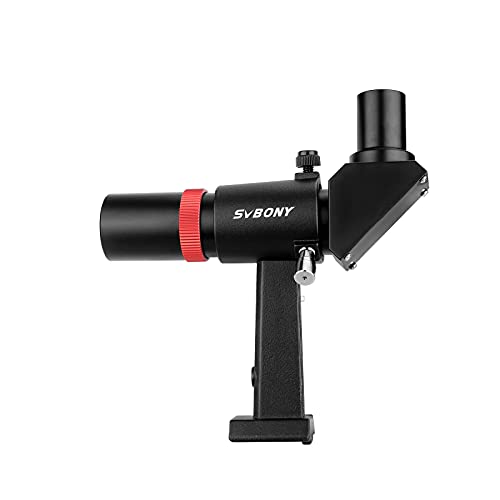
Designed for practical observing, the SV182 offers a 6x crosshair reticle and a 90-degree right-angle design for comfortable viewing. The 30 mm objective provides stronger light gathering for fainter objects, and the bracket system supports stable alignment with a range of telescope tubes. The combination of crosshair and adjustable focusing aids precise target placement before observing through the main scope.
Astromania Finder Scope 9×50
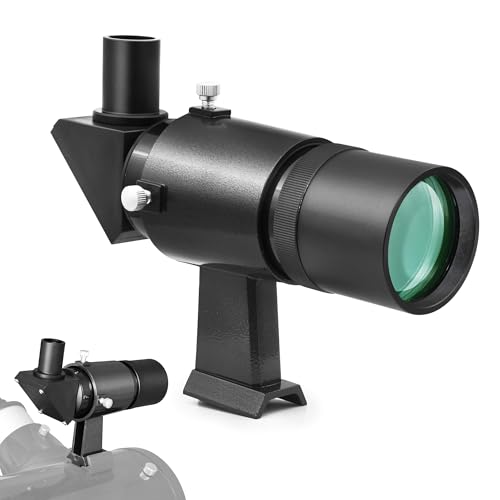
The Astromania 9×50 finder brings a brighter view with a 50 mm objective and upright corrected image. The 9x magnification expands the search field, making it easier to pinpoint DSOs in dense star fields. The 90-degree viewing angle improves comfort, especially when scanning near the zenith, and the included bracket supports stable mounting on compatible tubes.
SVBONY SV208 Finder Scope

The SV208 features an 8×50 configuration with an illuminated reticle, aiding alignment in very dark skies. The erect image and helpful field of view allow straightforward aiming, while the built-in LED reticle illumination improves accuracy during late-night sessions. This model suits observers who want precise, visible crosshairs without sacrificing a compact form factor.
Buying Guide: Key Purchase Considerations
- <strongObjective Size and Magnification: Larger objectives gather more light for fainter targets, but can add weight. A balance between magnification (for accuracy) and a wide field of view (for quick scanning) is essential.
- <strongImage Orientation: Upright-corrected finders present the sky as you see it with the naked eye, simplifying target identification, especially for beginners.
- <strongIllumination: Red-dot or illuminated reticles help in dark skies but may affect night vision if too bright. Look for adjustable brightness.
- <strongMounting Compatibility: Ensure the finder fits your telescope’s tube diameter and dovetail or bracket system. Some models include adaptable brackets for common tubes.
- <strongEase of Use and Alignment: Quick alignment features, such as “point & look” red-dot systems, reduce setup time between targets.
- <strongDurability and Weather Resistance: Metal housings typically offer better durability for field use; consider coatings that resist dew and temperature changes.
- <strongBudget and Value: A solid finder scope can be a long-term, low-maintenance component that improves overall observing experience. Weigh the features against the price to determine best value.
When selecting a finder scope, consider your telescope type (refractor, reflector, or compound), your typical observing targets (planetary vs deep-sky), and your local night-sky conditions. A right-angle finder with an upright image is often more comfortable for extended sessions, while a red-dot finder excels in quick object localization. For beginners, a simple Telrad or a StarPointer-style system can significantly reduce the learning curve, whereas more advanced users may prefer illuminated crosshair finders for precise alignment in challenging skies.