Stacking toys help toddlers build fine motor skills, hand-eye coordination, and early math concepts through play. This guide highlights five reliable options that balance sensory engagement, durability, and educational value. Each product below includes a quick overview of key features to help caregivers choose toys that suit their child’s age and interests.
| Product | Brand | Age Range | Notable Features |
|---|---|---|---|
| JUXUE Baby Spinning Stacking Toys | JUXUE | 12 months+ | |
| Sassy Stacks Of Circles Stacking Ring | Sassy | 6+ months | |
| LTKFFFdp Baby Stacking Toys | LTKFFFdp | 6-36 months | |
| Melissa & Doug Alphabet Nesting & Stacking Blocks | Melissa & Doug | 2+ | |
| Melissa & Doug Rainbow Stacker | Melissa & Doug | 2+ |
JUXUE Baby Spinning Stacking Toys
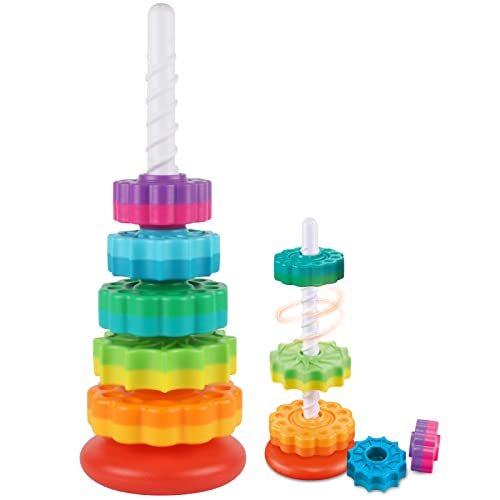
The JUXUE spinning stacking toy combines a screw rod with a rainbow wheel to create engaging, multitask play. Toddlers can stack discs, rotate them, and then release to observe motion. The discs’ two-color design supports color recognition as a foundational math and science activity. The toy encourages cause-and-effect learning while promoting dexterity and hand-strength as little hands manipulate the pole and bases. Suitable for ages 1 and up, it also serves as a sensory learning toy that supports early exploration and focus in short play sessions.
Sassy Stacks Of Circles Stacking Ring

The Sassy stacking rings provide a straightforward approach to building fine motor skills and hand-eye coordination. The straight post design accommodates rings of varying sizes, with each piece offering a different texture and weight. This textural variety supports oral exploration and sensory learning, while the progressive stacking reinforces size differentiation, sequencing, and spatial awareness. The chunky rings are easy for tiny fingers to grasp, making it a reliable option for infants beginning stacking play.
LTKFFFdp Baby Stacking Toys

This set blends nesting cups with shape sorting and counting-friendly elements. The 8 colorful cups feature animal prints, while additional blocks and shapes expand play potential. Toddlers can stack, nest, count, and sort to build early geometry and color skills. The design supports both independent play and guided activities, promoting sitting, standing, and reaching tasks as kids arrange cups by size or color. It’s a versatile option for indoor and outdoor use, with durable construction tailored for rough toddler handling.
Melissa & Doug Alphabet Nesting Blocks

This set includes 10 cardboard nesting blocks, each with unique sizes, letters, and familiar pictures. Blocks nest neatly for compact storage, helping caregivers organize play spaces while teaching early literacy. Children can explore letter recognition, picture associations, and sequencing as they stack and unstack. The FSC-certified materials align with safety and sustainability expectations, offering a durable, beginner-friendly introduction to nesting blocks that grow with a child’s curiosity.
Melissa & Doug Rainbow Stacker

The Rainbow Stacker is a timeless wooden toy featuring seven bright rings and a red topper on a rocking base. Its durable craftsmanship provides long-lasting use as children learn to stack by size and fit. The wooden construction offers a tactile feel and steady weight, supporting grip development and fine motor precision. The engaging rocking base adds dynamic play opportunities, encouraging balance and coordination as kids experiment with order and rhythm while stacking the rings.
PEBIRA Montessori Sorting & Stacking Toys

The PEBIRA wooden sorting and stacking puzzle includes 20 pieces across five colors and five shapes. It emphasizes color recognition, shape differentiation, and early geometry, while encouraging children to match blocks to targets or create new compositions. The design fosters hand-eye coordination and problem-solving as kids explore fit, alignment, and spatial relationships. This Montessori-inspired toy is well-suited for toddlers and preschoolers seeking a durable, educational stacking experience with varied play possibilities.
Buying Guide: Key Considerations For Stacking Toys
- Age appropriateness and developmental goals: Look for toys that match a child’s age and skill level, with room to grow into more complex stacking challenges.
- Material and durability: Wooden options tend to last longer and withstand rough handling, while plastic variants may be lighter and easier to clean.
- Fine motor and hand-eye coordination focus: Many stacking toys incorporate grip strength, pinching, and precision placement to support motor development.
- Color, shape, and number concepts: Toys with color differentiation, shape sorting, and counting features can reinforce early math literacy.
- Sensory and texture variety: Textured rings, smooth cups, and varied surfaces provide tactile stimulation and encourage exploration.
- Storage and portability: Nesting and stackable designs help keep play areas organized and portable for travel or quick setup.
- Safety considerations: Ensure rounded edges, non-toxic finishes, and age-appropriate size to prevent choking hazards.
- Interactivity and guided play: Some toys support independent stacking, while others work with caregivers on structured activities to promote language and social interaction.
- Value and versatility: Multi-piece sets that offer stacking, nesting, counting, and sorting provide longer-lasting engagement compared to single-function toys.
- Brand reliability and reviews: Choose well-reviewed products from reputable brands with documented safety standards.